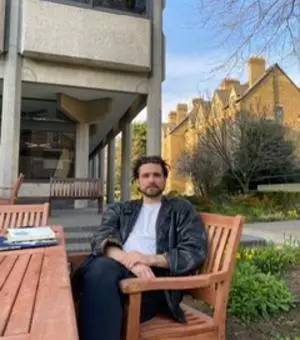

Gustavo Cabrera Pinzon
DPhil Student
gustavo.cabrera@keble.ox.ac.uk
DPhil Research Topic: The Different Languages of Democracy in Early Republican Mexico. 1810-1850
In the Atlantic world the invocation of the word democracy was layered, precise, and strategic. It had the power of being used as a weapon as well as connote political allegiance and political ideological beliefs. In the relatively short period of fifty years (1800-1850) the word "democracy" went from having negative connotations in the Atlantic world, to being the chosen political system by liberal systems of government. How was the language of democracy utilized before its consolidation as one of the main identities of the Mexican state? Did race and ethnicity play a role in the invocations of this term? Were early nineteenth century uses of the language of democracy reflected in democratic practices? Did early forms of republican traditions influence the way the word spread and was understood? These are just some of the questions I mean to explore. In its exploration of the ways in which different layers of Mexican society spoke the language of democracy, this project will mix aspects of political and intellectual history. As such, the project aims to contribute to the historical analysis of the effects of enlightenment language on politics, whose literature has mostly focused on the North Atlantic but is beginning to shine light into previously overlooked regions, such as Latin America.
I graduated from the University of St Andrews in 2023 with an MA in Modern History and International Relations. I then went to study an MSc in Latin American Studies at the University of Oxford, where I wrote a dissertation that traced the evolution of Mexican nationalism from 1823 to 1910. I am a local of Mexico City.
My DPhil is generously funded by the Secretaria de Ciencia, Humanidades, Tecnología, e Innovación of the Mexican Government.
Supervisor: Eduardo Posada Carbo