Dr Eric Schluessel

Associate Professor in Modern Chinese and East Asian History, Tutor in History
Keble College
eric.schluessel@keble.ox.ac.uk
I research the social and cultural history of China and Central Asia from the 1750s through the 1950s with a focus on Xinjiang. Before joining Oxford, I was associate professor of history and international affairs and director of the Sigur Center for Asian Studies at the George Washington University. I previously taught at the University of Montana and held a fellowship at the Institute for Advanced Study. I am an associate editor of the Journal of Chinese History, the Journal of Central Asian History, and Late Imperial China.
Research Interests
My current research concerns the grassroots social and economic history of Xinjiang (East Turkestan), particularly the ways that ordinary farmers, artisans, and merchants navigated the reorientation of the region's economy towards South, Central, and East Asia from the mid-nineteenth century through the early PRC. I explore in particular the ways that Chinese merchants came to control sectors of the economy that were deeply embedded in Islamic piety, and how local actors and institutions then adapted to newly dominant practices of exchange. Much of this work is heavily empirical in that it involves extracting basic information about things like the locations of markets from sources in Chinese, Chaghatay, Manchu, and other languages.
Relatedly, I am working on a monograph revisiting the origins of the so-called 'Muslim uprisings' of 1864. That year, a series of revolts across Xinjiang weakened Qing control. In the vacuum of Qing power, multiple local leaders, most of them longtime Qing loyalists, competed to establish legitimate states. Standard accounts of the rapid outbreak of violence focus on secret conspiracies and use people's identities or origins to explain their actions. My project looks back at the social roots of each event and centers the importance of religion and ritual in motivating and shaping conflict. By looking closely at how local actors mobilized their constituencies for violence, we can illuminate much about patterns of social organization, practices of securing and maintaining loyalty, and ideas of legitimacy that were largely invisible to the central Qing state.
This work builds on my first monograph, Land of Strangers: The Civilizing Project in Qing Central Asia (Columbia University Press, 2020), which won the Fairbank Prize for East Asian History in 2021. Land of Strangers explores the aftermath of a three-decade-long project to transform the Turkic-speaking Muslims of Xinjiang into Chinese-speaking Confucians in the wake of the Muslim uprisings. Subsequently, I published a translation of a key Uyghur historical work that discusses the uprisings and postwar reconstruction from a local perspective, Musa Sayrami's Tarikh-i Ḥamidi (Columbia University Press, 2023). I was also proud to co-edit the volume Community Still Matters: Uyghur Culture and Society in Central Asian Context (NIAS Press, 2022) with Dr. Aysima Mirsultan and Dr. Eset Sulaiman.
I also frequently translate from Chinese, Uyghur, and Chaghatay. I teach the latter language, which was one of the common languages of Central Asia from the 1400s into the 1950s, using my textbook, An Introduction to Chaghatay: A Graded Textbook for Reading Central Asian Sources (2018).
Publications
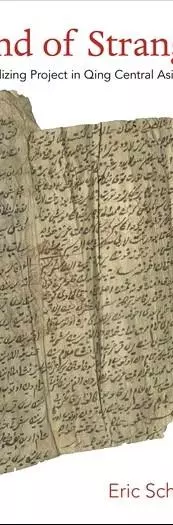
Land of Strangers: The Civilizing Project in Qing Central Asia
In Land of Strangers, Eric Schluessel explores this encounter between Chinese power and a Muslim society through the struggles of ordinary people in the oasis of Turpan. He follows the stories of families divided by war, women desperate to survive, children unsure where they belong, and many others to reveal the human consequences of a bloody conflict and the more insidious violence of reconstruction. Schluessel traces the emergence of new struggles around essential questions of identity, showing how religious and linguistic differences converged into ethnic labels.
DPhil Students
I would like to hear from potential DPhil and Masters Students regarding the history of eighteenth through early twentieth century China, especially those working on transcultural frontiers and Islam.