

Patronage and Power in the Pre-Modern Mediterranean
Monumental Donor Epigraphy on Mt Athos
AHRC-DFG Research Project (2026-2029)
Principal Investigators: Ida Toth (Oxford) and Nicholas Melvani (Mainz)
Research Associate: Nathan Websdale (Oxford)
Dr Ida Toth discusses her new AHRC-DFG funded research project, focusing on medieval and early modern donor epigraphy of Mount Athos (also known as the Holy Mountain) in Northern Greece. This inscriptional material offers insights into the strategies of self-presentation employed by the patrons of the Athonite monasteries. At its core, the project seeks to clarify the questions of agency and reception. Who commissioned donor inscriptions? What messages did patrons intend to convey? How should these messages be understood within the broader Eastern Mediterranean world?
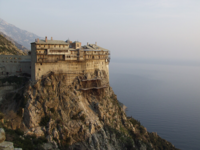
View of the monastery of Simonos Petra, Mt Athos
Mount Athos (Northern Greece) stands as a testament to remarkable historical resilience. Originally an isolated refuge for hermits wishing to withdraw from secular life, this rocky peninsula developed into one of the best organised and most populous religious centres in medieval Europe. Throughout the medieval period, the peninsula’s coenobitic monasteries – most of them founded during the 10th and 11th centuries – attracted the patronage of a diverse array of elites from the Eastern Mediterranean, the Balkans, Anatolia, and the Caucasus. Its history is not only one of spiritual continuity, but also of sustained engagement with the shifting imperial and regional powers. A focal point for both religious devotion and political ambition in the Byzantine and Ottoman worlds, Mount Athos (also known as the Holy Mountain) cultivated a legacy that continues to shape modern Orthodox Christianity.
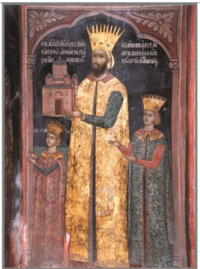
Donor portraits and inscriptions Monastery of Docheiariou, Mt Athos
Donor Inscriptions: Unmediated Voices of Patronage
While Athonite history has traditionally been viewed through the prism of narrative accounts, archival documents, and rich evidence of material culture, the peninsula’s epigraphic record remains comparatively neglected. Approximately 600 extant inscriptions – many of them paired with striking donor portraits - offer illuminating insights into the strategies of self-presentation employed by the patrons of these monastic establishments. This corpus also highlights the complex interplay between word and image, particularly in Athonite settings where inscriptions of diverse cultural and linguistic origins appear side by side.
Addressing a broad viewing audience from across the Christian oikoumene, these epigraphs provide a wealth of information on patronage as a principal factor in ensuring the longevity and survival of Mount Athos. They reveal how epigraphy was deployed to communicate messages of benefaction and piety thus transforming sacred spaces into public fora for personal and political self-display.
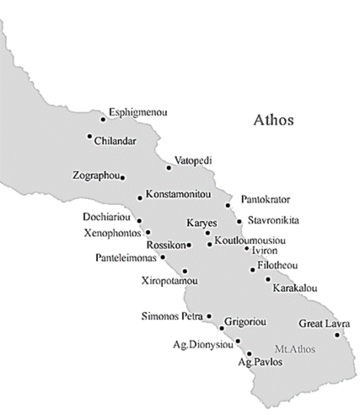
Map of the Mt Athos peninsula showing the locations of the 20 monasteries
Temporal and Spatial Scope of Inquiry
To fully understand this epigraphic habit, our project will produce the first comprehensive corpus of donor inscriptions from all twenty Athonite monasteries, as well as from the Protaton, the peninsula’s central administrative church. Chronologically, the study spans from the 10th to the 17th centuries. This period encompasses the formation of the monastic communities and their development under two successive imperial frameworks: Byzantine and Ottoman. The 17th century marks a deliberate endpoint. In the 18th century, the national independence movements and the reforms of the Ottoman state reshaped social structures and introduced new political agendas. These changes significantly altered patterns of patronage and the character of epigraphic expression, signalling a transition into a distinctly modern historical context.
Objectives and Broader Scholarly Contributions
At its core, the project seeks to clarify the questions of agency and reception. Who commissioned these inscriptions? What messages did patrons intend to convey? How were these messages understood within the broader Eastern Mediterranean world?
By creating a centralized Database of Athonite Inscriptions, the project will make accessible a significant body of evidence that has long remained physically dispersed and difficult to consult. Yet the aim extends beyond documentation. By situating these inscriptions within their religious, cultural, historical, and geographical contexts, the research will contribute to the broader discussions about the mechanisms that sustained Mount Athos as a trans-regional monastic centre over many centuries, and – more broadly – about the representations of patronage in pre-modern sacred spaces.
For further information about the project, please contact: ida.toth@history.ox.ac.uk


