Carlo Ginzburg (15 April 1939-17 June 2026)
Ⓒ John-Paul Ghobrial
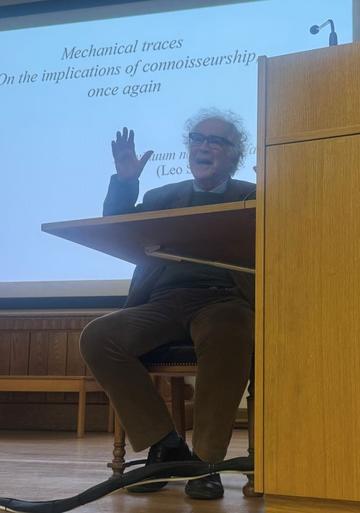
When he delivered the annual lecture of the Oxford Centre for European History on 20 May 2025 (pictured), more than 200 people came to hear him speak, with many students queuing for an hour for an autograph on their copies of his books. Anyone who has met him remembers his combination of intellectual rigour and generosity.
Born into an anti-Fascist family, Ginzburg spent his first few years first in internal exile and then in hiding. He studied at the Scuola Normale Superiore in Pisa and taught at the University of Bologna until the 1980s, then at UCLA until his retirement, while also holding a chair at the Normale from 2006. Ginzburg always maintained a strong civic commitment to the present, which is one of the many distinctive features of his work. Another one was his pioneering engagement with historical method, largely shaped by a recognition of the historical insight offered by anomalies and exceptions. His first book, Night Battles (1966), did not only shed light on a previously undiscovered agrarian cult but investigated the relationship between dominant and subaltern culture, building on Antonio Gramsci’s categories. Published in 1976 and translated into some thirty languages, The Cheese and the Worms remains one of the most widely read pieces of historical writing in the world. His research into the culture and minds of peasants who left no written sources of their own contributed to the foundation of microhistory, of which Carlo was one of the most famous pioneers and practitioners. In 1989, Ecstasies again defied convention by examining the roots of the witches’ sabbath on a Eurasian scale over the very long durée. Engaging in close conversation with ancient and modern historians, anthropologists, art historians, literary critics and philologists, he published hundreds of shorter essays and articles, which have been equally influential. Perhaps most famously, ‘Clues’ traced the origins of the microanalytical method back to prehistoric hunters, via medicine, connoisseurship, and psychoanalysis. In 1975, he and Adriano Prosperi published a book on a seminar they had conducted with students on an obscure heretical text that circulated abundantly in sixteenth-century Italy, but which was then only known from one surviving copy. It has just been translated into English as Puzzles and remains an inspiring lesson in investigative research, collaborative work, and dialogue with students and colleagues.
We like to remember Ginzburg’s incessantly thought-provoking and irreverent attitude with the words spoken by his Menocchio before the Inquisition: ‘I have a subtle mind and I sought after lofty things which I did not know about’.
Filippo de Vivo and Giuseppe Marcocci

