

Who dressed the urban bombers?
By Rushita Mopidevi
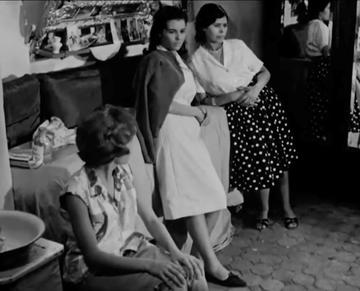
Image from The Battle of Algiers.
“As Joanne Entwistle has remarked, dress “operates at the interface between the individual and the social world … the private and the public”. And it is precisely because of this strategic positioning that dress functions as a salient and powerful political language”. – Jean Allman.1
The Algerian War of Independence (1954–62) was one of the bloodiest and most politically significant decolonisation struggles of the twentieth century. It pitted the National Liberation Front (FLN) against the French State and the majority of Algeria’s settlers, in a conflict that left hundreds of thousands dead and shattered the illusion that France’s “longest colony” could be held indefinitely. The stakes were high: with one million European settlers in Algeria, and Paris insisting the territory was an integral part of France. The outcome seemed certain to shape the future of empire itself.2
One of the conflict’s defining moments was the Battle of Algiers (1956–57), when the densely populated casbah became both the heart of FLN resistance and the site of ruthless repression. Gillo Pontecorvo’s 1966 film The Battle of Algiers remains the most widely recognised representation of this period, lauded for its astonishing realism. Its documentary-style reconstruction was so convincing that contemporary audiences often mistook it for archival footage and it continues to be studied by military institutions, including French and American intelligence, as a case study in counterinsurgency.3
The politics of Dress in the Battle of Algiers -
Yet beneath the familiar story of guerrilla tactics and state repression lies a less explored dimension: the politics of dress. Clothing, often coded as feminine, private, or apolitical, became a weapon in the Algerian struggle. Female FLN operatives famously disguised themselves in Western dress in order to pass through French checkpoints. Their transformed appearance allowed them to carry bombs into cafés and nightclubs in the French quarter, turning everyday attire into an instrument of war. In these moments, clothing did not simply conceal; it actively unsettled colonial power, exposing how fragile the boundaries between the coloniser and the colonised could be.4
Film vs. Autobiography: Competing Narratives -
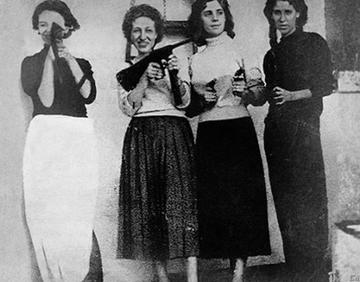
Image of four female members of the FLN (1956) who planted bombs during the Battle of Algiers: Samia Lakhdari, Zohra Drif, Djamila Bouhired and Hassiba Ben Bouali.
Pontecorvo dramatises this in one of the film’s most striking sequences: women removing their veils in the casbah, altering their appearance and then slipping through French cordons to plant explosives. These images pay tribute to women’s tactical ingenuity, but the film stops short of granting them full political subjectivity. Out of the film’s 121 minutes, women appear on screen for little more than fifteen and their voices are almost entirely absent.5 The same garments that allowed them to defy French surveillance and reshape the urban battlefield are presented visually but not narratively; women are seen, not heard.
This absence matters. As Zohra Drif’s autobiography, Inside the Battle of Algiers: Memoir of a Woman Freedom Fighter, makes clear, women were not simply symbols but conscious strategists. Drif, one of the three women who planted bombs in the French quarters, recounts the intimate decisions, risks and debates behind those disguises. For her and others, adopting Western dress was not just camouflage; it was a deliberate weaponisation of colonial expectations about gender, respectability and visibility. She says she wore:
“An elegant summer dress … It was a lavender blue … that perfectly matched my cork-wedge summer shoes in the same color. When trying it all on we had confirmed that, with our new haircuts and makeup, we would blend in perfectly among the European jeunesse dorée—even the most well-to-do among them.”6
The Battle of Algiers is thus doubly instructive. It offers an enduring portrayal of urban insurgency and state repression, while also exposing how women’s resistance, especially through something as everyday as clothing, was celebrated visually yet muted politically. Reading the film against Drif’s autobiography reminds us that clothing can be both an armour and an archive and that the politics of dress in Algeria was not secondary but a central battlefield in the struggle for liberation.7
Silences, Class and the Erasure of Women -
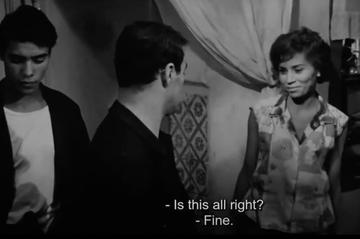
Image from The Battle of Algiers - Saadi Yacef approving women on their looks.
French colonial authorities long assumed that women were apolitical actors whose loyalties could be read directly off their clothing. This ignorance became a weakness. Algerian women weaponised it by adopting European fashion to enact violence.8 In The Battle of Algiers, this appears as a dramatic sequence of unveiling: women discard the veil and step into modernity. Yet this framing is historically misleading. The women who partook in the bombings were generally, though not exclusively, from middle-class families who received secondary or higher education. As much, they typically did not wear the veil in the first place.9
This distinction matters. The film’s unveiling scene reproduces a Fanonian narrative of veiling/unveiling as revolutionary rupture, but it obscures the lived reality: the women’s disguises were not individual acts of transformation, but the outcome of collective labour. In her autobiography, Drif recalls how a network of women, led by Mama Zohra, styled their hair, applied their makeup and perfected their outfits so they could pass as European. What the film shows as solitary women at a mirror and whose efforts were assessed and approved by men, was, in fact, an intimate act of solidarity amongst women.10
But Drif tells us the real story:
“Then came selecting our outfits, bags, shoes, hair, and makeup. Supervised by Mama Zhor, who was infallible in these subjects, we bought summer dresses and the smartest matching shoe-and bag combinations and went to Roques, the best hairdresser, whose haircuts transformed me into a true Bretonne woman and Samia into a real Corsican. Having never done our makeup before, we let the salon’s specialist (guided, of course, by Mama Zhor) layer on all the necessary products, explaining the secrets of discreet yet effective application as she put her precious advice into practice on our faces”. 11
Yet, Mama Zohra and this community are silenced. They appear only in a single sentence in Drif’s autobiography, absent from archives and entirely erased in cinematic retelling. This silence is not neutral. It reveals how class and respectability shaped the archive: Drif, educated and from a middle-class family, was able to narrate her role and be celebrated as a heroine. By contrast, these communities of women, likely domestic workers, homemakers, hairdressers, or even women working in brothels were excluded precisely because their social position made their labour appear less respectable, less political and therefore less worthy of remembrance even though they were the ones who held the specialist knowledge that the insurgency heavily relied upon.12
The question of women working for brothels is especially revealing. In The Battle of Algiers, brothels appear in the FLN’s moral ‘clean-up’ campaign, as prostitution is framed as a stain on the national body. Yet archival accounts complicate this picture. Writing under the pseudonym Saadia-et-Lakhdar, Salima and Rabah Bouaziz recalled women who worked in brothels and dancers who joined the national struggle. For one woman, this involvement was a kind of moral redemption:
“I am free from this dirty job, thanks to God and the trust which our brothers give us”. 13
At the same time, women like Baya Hocine later recalled that these women were also subject to violence:
“They tried to ban prostitution, sometimes they picked them up. They beat them… I didn’t agree, but I had no power because what [these women] did was not pretty, at least according to the morals of the time”. 14
This complicates the narrative of women in the Algerian war. They show that while nationalist discourse and films like The Battle of Algiers erased or moralised women who worked in brothels, in practice, they were indispensable actors in the struggle. The women deemed ‘criminal’ or ‘immoral’ by both colonial authorities and nationalist men held the specialist knowledge and street-level networks that resistance depended upon.
Critical Fabulation and Recovering the Unseen -
Here, Saidiya Hartman’s notion of critical fabulation becomes especially useful. Hartman invites us to confront the silences of the archive not as neutral gaps but as evidence of whose lives were deemed unworthy of record. Instead of accepting these erasures, she urges us to speculate responsibly, to imagine the lives and labours that sustained resistance but were excluded from memory.15
In this case, critical fabulation would allow historians and scholars to ‘see’ the forgotten women behind Drif’s story. By looking at the above quotes, to suggest that the women that helped Drif and other female bombers get ready may have been working class, or part of a stigmatised profession, is not idle guesswork: it is a way of making visible the structures of exclusion that shape both colonial and nationalist memory. These women appear only fleetingly, if at all, in the official record, but through Hartman’s method they can be re-centred as indispensable actors in the anti-colonial struggle.
This approach resonates with the work of Nassima Mekaoui-Chebout, a PhD researcher on working-class women in Algeria. She stresses that uncovering these hidden figures requires drawing on wide range of sources, including “newspapers, judiciary archives, birth, death and marriage certificates”, where women appear only fleetingly, often in a single line. She highlights that having a “peculiar gaze as a feminist from below (mostly from an antiracist and subalternist point of view) on the sources is important”.16 Read alongside Hartman’s method, these fragmentary traces invite us to imagine lives otherwise erased and to restore working-class women as political subjects in their own right.
Foregrounding this silence makes clear that nationalist memory was not only gendered but stratified by class. The glamour of Drif’s lavender dress and cork-wedge shoes survives in history, but the unseen hands that styled her hair and applied her makeup have been forgotten. Without them, the performance of European femininity that made the bombing possible could not have taken place. Critical fabulation offers a way to bring these women back into view, not as passive shadows, but as active agents whose labour shaped the struggle.17
Colonial Myths and the Shock of Modern Militancy -
Viewing dress as a political weapon, rather than simply a disguise, reveals it as a direct challenge to colonial ideology. France casted unveiling and Western fashion as proof of assimilation and modernity, but when Algerian women used these styles to carry out resistance, they stripped them of colonial meaning. Consequently, clothing no longer signified submission and instead, it became a tool of rebellion.18
Pontecorvo famously stages the scene of women removing their veils before infiltrating the European quarter. Yet, as already discussed, Drif and her fellow bombers were already unveiled. Why, then, does the film insist on showing an unveiling? The answer lies in competing colonial and nationalist imaginaries. For colonial France, unveiling had long been a metaphor of assimilation; for nationalist men, women’s militancy was palatable only if framed as an extraordinary rupture with tradition. By portraying the female bomber as a woman who first ‘sacrifices’ her cultural authenticity, the film masculinises resistance and renders women as symbols rather than as political agents. Their militancy is treated as exceptional, rather than as a continuation of their everyday modern urban lives.19
This distortion matters. Drif’s autobiography, restores women’s voices by showing the range of their roles - strategists, couriers, comrades, motivated by conviction, not by symbolic rupture. Her testimony also highlights how women’s appearance unsettled colonial ideology.20 France had justified its continued presence in Algeria as a civilisational mission, contrasting its supposed modernity with the “backwardness” of Muslim gender relations. The participation of unveiled, educated women in anti-colonial struggles exploded this narrative. If these ‘modern’ women stood with the FLN, France’s claim to represent progress collapsed. In the eyes of international observers, the very women France held up as proof of its civilising mission became evidence of its failure. This reversal carried weight beyond Algeria itself: it undermined France’s credibility on the global stage, especially at the United Nations, where decolonisation was increasingly framed as a test of international legitimacy. The sight of educated Muslim women actively resisting French rule suggested that the empire was neither modernising nor emancipatory, but repressive and obsolete. Thus strengthening international sympathy for Algerian independence and eroding France’s standing as a colonial power. 21
Dress thus unsettled both colonial and nationalist powers. Nationalists sought to recast women as symbols of authenticity, while the French read dress one-dimensionally as evidence of assimilation. Neither perspective captured the lived complexities of women who used clothing as a tactical tool and as a means of asserting agency.
Critical Fabulation and Recovering the Unseen -
This raises the wider question: how many stories have been silenced because they did not “look” political enough? Figures like Drif remain visible in Algeria, but internationally women are too often reduced to symbols, their contributions sidelined in archives and films alike. To overcome this, scholars should utilise Hartman’s “critical fabulation” to read against silence, to trace gaps and to reimagine women back into the histories that erased them.
Conclusion: Why it matters today -
Seen in this light, the politics of dress forces us to expand what we think of as resistance. The battlefield of decolonisation ran not only through streets and battlefields but also through makeup, salons and clothing. Recognising this reframes decolonisation as a struggle fought as much in the everyday as in the spectacular and reminds us that women’s voices are central to telling the full story. This is why the home as a political space is so important for how we remember decolonisation: it reveals that the private sphere was never apolitical but a crucial site where resistance was forged and sustained. By foregrounding these spaces, we challenge traditional histories and instead recognise how decolonisation was sustained through the everyday.
- Jean Allman, Fashioning Africa: Power and the Politics of Dress, (Bloomington: Indiana University Press, 2004), 2.
- Elizabeth Perego, “The Veil or a Brother’s Life: French Manipulations of Muslim Women’s Images during the Algerian War, 1954-62”, The Journal of North African Studies 20, no. 3 (2015): 351.
- Amrane Minne, Danièle Djamila, and Alistair Clarke, “Women at War: The Representation of Women in The Battle of Algiers”, Interventions (London, England) 9, no. 3 (2007): 342.
- Minne, Djamila and Clarke, “Women at War”, 342; Perego, “The veil or a brother's life”, 354; Giselle Aris, “The Power and Politics of Dress in Africa,” Pennsylyvania Scholarly Commons, 2006, 11.
- Minne, Djamila and Clarke, “Women at War”, 342; Jacques Lezra, “Three Women, Three Bombs”, in Wild Materialism, (Fordham University Press, 2010), 182; Zahia Smail Salhi, “The Algerian Feminist Movement between Nationalism, Patriarchy and Islamism”, Women’s Studies International Forum 33, no. 2 (March 2010): 116.
- Zohra Drif, Inside the Battle of Algiers: Memoir of a Woman Freedom Fighter, Trans. Andrew Farrand, (Charlottesville, Virginia: Just World Books, 2017).
- Allman, Fashioning Africa.
- Perego, “The veil or a brother's life”, 354; Natalya Vince, “Colonial and Post-Colonial Identities: Women Veterans of the “Battle of Algiers”, French History and Civilisation, 2, (2009): 157.
- Maya Montgomery, “Algerian Women in the Battle of Algiers And Beyond”, ed. Tahira Ismail, Clay Capra, Madison Bee, Justin Hawkins, Sydney Heise and Kevin Ryan, University of Maryland, The Undergradaute History Journal, (2019): 18; Perego, “The veil or a brother's life”, 356.
- Drif, Inside the Battle of Algiers; Sara Rahnama, “Hijabs and Hats in Interwar Algeria”, Gender & History 32, no. 2 (June 22, 2020): 436.
- Drif, Inside the Battle of Algiers.
- Montgomery, “Algerian Women in the Battle of Algiers And Beyond”, 25; Dina Heshmat, “Tracking Down Anticolonial Feminist Militants in the Archive”, Journal of Middle East Women’s Studies 21, no. 1 (2025): 120.
- Saadia-et-Lakhdar, L’aliénation colonialiste et la résistance de la famille algérienne (Lausanne, La Cité, 1961), p. 140. The study was also published in Les Temps Modernes; Natalya Vince, Our Fighting Sisters: Nation, Memory and Gender in Algeria, 1954-2012, (Manchester: Manchester University Press, 2015).
- Amrane, Des Femmes dans la guerre d’Algérie, p. 146; Vince, Our Fighting Sisters.
- Saidiya Hartman, “Venus in Two Acts”, Small Axe 12, no. 2 (2008).
- Interview with Nassima Mekaoui-Chebout, author of the thesis ‘L’art de supporter. Travailleurs et travailleuses domestiques en situation coloniale (Algérie, 1830-1962)’ [The art of supporting/ putting with: Male and Female Domestic Workers in a Colonial Situation (Algeria, 1830-1962), PhD Thesis (2015).
- Hartman, “Venus in Two Acts”.
- Allman, Fashioning Africa, 31; Vince, “Colonial and Post-Colonial Identities”, 157; Aris, “The Power and Politics of Dress in Africa”, 2.
- Frantz Fanon, “Algeria Unveiled”, in Decolonization: Perspectives from Now and Then, ed. Prasenjit Duara, (Hoboken: Taylor and Francis, 2003); Montgomery, “Algerian Women in the Battle of Algiers And Beyond”, 23; Lezra, “Three women, three bombs”, 183; Perego, “The veil or a brother's life”, 350.
- Drif, Inside the Battle of Algiers
- Perego, “The veil or a brother's life”, 350- 354; Vince, “Colonial and Post-Colonial Identities”, 158.
Further readings/ bibliography:
Primary:
- Drif-Bitat, Zohra. Inside the Battle of Algiers : Memoir of a Woman Freedom Fighter. Translated by Andrew Farrand. Charlottesville, Virginia: Just World Books, 2017.
- The Battle of Algiers . Monogram Pictures, 2003.
Secondary:
- Allman, Jean Marie. Fashioning Africa : Power and the Politics of Dress. Bloomington: Indiana University Press, 2004.
- Amrane Minne, Danièle Djamila, and Alistair Clarke. “Women at War: The Representation of Women in The Battle of Algiers.” Interventions 9, no. 3 (2007): 340–49. https://doi.org/10.1080/13698010701618562.
- Amrane Minne, Des Femmes dans la guerre d’Algérie.
- Aris, Giselle. “The Power and Politics of Dress in Africa.” Pennsylyvania Scholarly Commons, 2006. https://core.ac.uk/download/pdf/214130366.pdf.
- Hartman, Saidiya. "Venus in Two Acts." Small Axe 12, no. 2 (2008): 1-14. https://muse.jhu.edu/article/241115
- Heshmat, Dina. “Tracking Down Anticolonial Feminist Militants in the Archive.” Journal of Middle East Women’s Studies 21, no. 1 (2025): 115–21. https://doi.org/10.1215/15525864-11575535.
- Frantz Fanon. “Algeria Unveiled”. In Decolonization: Perspectives from Now and Then. Edited by Prasenjit Duara. Hoboken: Taylor and Francis, 2003.
- Lezra, Jacques. “Three Women, Three Bombs.” In Wild Materialism. Fordham University Press, 2010.
- Montgomery, Maya. “Algerian Women in the Battle of Algiers And Beyond”. Edited by Tahira Ismail, Clay Capra, Madison Bee, Justin Hawkins, Sydney Heise and Kevin Ryan. University of Maryland, The Undergradaute History Journal, (2019): 15-25. https://www.umdjanus.com/_files/ugd/15371a_0c1908859df8485e816b3d28185ca031.pdf#page=17.
- Perego, Elizabeth. “The Veil or a Brother’s Life: French Manipulations of Muslim Women’s Images during the Algerian War, 1954-62.” The Journal of North African Studies 20, no. 3 (2015): 349–73. https://doi.org/10.1080/13629387.2015.1013942.
- Rahnama, Sara. “Hijabs and Hats in Interwar Algeria.” Gender & History 32, no. 2 (June 22, 2020): 429–46. https://doi.org/10.1111/1468-0424.12483.
- Salhi, Zahia Smail. “The Algerian Feminist Movement between Nationalism, Patriarchy and Islamism.” Women’s Studies International Forum 33, no. 2 (March 2010): 113–24. https://doi.org/10.1016/j.wsif.2009.11.001.
- Saadia-et-Lakhdar, L’aliénation colonialiste et la résistance de la famille algérienne. Lausanne, La Cité, 1961.
- Vince, Natalya. “Colonial and Post-Colonial Identities: Women Veterans of the “Battle of Algiers”. French History and Civilisation, 2, (2009): 153-168.
- Vince, Natalya. Our Fighting Sisters: Nation, Memory and Gender in Algeria, 1954-2012. Manchester: Manchester University Press, 2015. https://doi.org/10.7765/9780719098833.