

Dealing with the Unknown in the Production of Knowledge: Women and Nationalist Histories
By Aymara Q. Salinas
Undertaking a research internship at the University of Oxford, the project centred around exploring African women’s role in decolonisation. Being primarily interested in intellectual history, I have often had seemingly endless materials to read - the writings of select ‘thinkers’, records of their lives, how their ideas were disseminated and the ensuing intellectual exchanges. Starting this project, however, I was very abruptly struck by just how little there was to read; records on African women and their lives were increasingly hard to source. Accordingly, an issue I quickly ran into was how does one research histories not yet written or scarcely recorded? How can we navigate these gaps in the archives?
Archival Absences and Omissions
This challenge is one that historians have been grappling with for many years. There have been efforts to directly create records on African women as a form of ‘recovery’. For example, from the early 2000s the Women Writing Africa Project sought to tell untold stories by collecting and publishing the writings of African women over centuries - from songs and poetry to journals and letters.[1] This project questioned why materials that clearly existed were not given attention. Why were these women’s contributions not registered as ‘knowledge’ worth documenting? Why were these forms of intellectual production excluded? As Abenia Busia, one of the co-editors of the project, writes, “the inability to be conscious of women’s stories seemed to me an even greater betrayal than the absence of the texts themselves”.[2] These ‘gaps’ in the archives are often not neutral absences but quite intentional omissions.
Beyond this, many ‘absences’ can also be explained by the fact some stories have not been recorded, and others have been lost. With this idea of ‘recovering’ women’s voices and stories, either lost or made absent, I began to consider what might be appropriate speculation to fill in these ‘gaps’. Here, Saidiya V. Hartman’s concept of critical fabulation has been crucial in helping me answer this question. Originally utilising this in relation to enslaved peoples, Hartman’s critical fabulation posits that we can create narratives to theorise about what might have taken place, in the absence of recorded stories.[3] Though, Hartman remains firm on how the focus is not ‘filling in’ archival gaps and thereby washing away the violence of the archives, but rather we must sit with this uncomfortable reality.[4] While we do this essential task of tracing and speculating about these unrecorded lives, we cannot soften the blow of the violence of the archives; we cannot simply fix the result of a system rooted in erasing voices. Hartman’s work has been extremely impactful in allowing me to feel comfortable sitting with the unknown and has pushed me to question what we ‘know’ and why.
Women as Subjects of Imagery
As I began my research for the project, I saw that women frequently entered the archives as subjects of nationalist imagery. In particular, I became very interested in the case of Angola after seeing how imagery of motherhood was used by several different nationalist groups.[5] In a nationalist context, the image of the nurturing mother is used to represent her duty of caring for the nation as well as her children.[6] This was, however, a reoccurring trope in many African nations, not just Angola, as shown below with a poster I found in the Bodleian Archives [see Figure 1].[7]
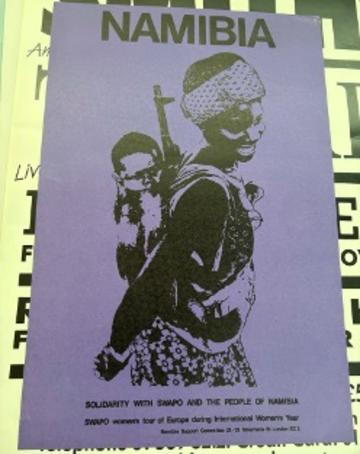
Figure 1: Poster produced by the Namibia Support Committee, 1975. Photograph taken by the author.
Viewing this poster, I was very struck by how imagery of motherhood could be both subversive but also ‘contain’ women. In one way, this imagery showed that motherhood did not confine women to the private sphere, but rather their ‘private’ identity as mothers could be carried into public politics – seen very explicitly as the woman carries both a baby and a gun. However, framing women’s contributions to the nationalist struggle within this motherhood trope meant that they still maintained an element of their ‘traditional’ role while engaging in politics – a ‘tolerable’ level of subversion. As Cynthia Enloe has very aptly put it, women served as “patriarchally sculpted symbols of the nation”.[8] With this, I wanted to understand how women moved past nationalist rhetoric that spoke about them and became active participants speaking for themselves.
Nationalist Histories and Women
As my intention was to centre women’s own voices, it was clear it would not be a straightforward task. I have touched upon how women’s histories have been made absent in several ways – the archive marginalises the voices of women, of African people, of the working-class, let alone working-class African women. However, when studying these women in relation to decolonisation specifically, there is another layer of erasure to consider.
Official histories of African nationalist projects have largely been written from the perspective of male participants, centring the actions of men, and excluding women’s contributions.[9] Where nationalist movements want to stress homogeneity, women’s separate demands, aims, and needs are often pushed to the sidelines - independence must come ‘first’. By minimising women’s contributions to the struggle, this allows for women’s demands (e.g., social equality and dismantling patriarchal structures) to be sidelined post-independence. These women’s contributions are not only unrecorded but intentionally excluded and minimised for political purposes.
As women have been largely written out of these nationalist histories, this silencing allows for an implicit assumption to be made - that women did not contribute to these ‘grand’ ideas of revolution, resistance, and liberation. I felt very strongly about challenging this assumption and was keen to see how women participated and might have engaged with wider intellectual exchanges, beyond being the subjects of imagery and discourse.
Transnational Networks and a Global Sisterhood
After sifting through various archival materials on Angolan nationalist organisations, on women’s groups, on missionaries, I eventually homed in on the Bodleian’s Anti-Apartheid Movement Collection. I became very interested in different international conferences as I saw that women from various countries directly participated. This highlighted to me that women were operating in very conscious and interconnected ways, creating networks with other women across Africa and the world. Existing scholarship on this topic has tended to focus on Western women and transnational connections,[10] though more recent attention has been given to women and Pan-Africanism,[11] and Global South women more broadly.[12] I therefore sought to build on this recent historiographical focus and explore how non-Western women engaged in these transnational networks.
One notable example I found comes from the 1982 International Conference on Women and Apartheid, held in Brussels. In an address by Jeanne Martin Cissé, Guinean politician and President of the Conference, she recognises “African women are doubly discriminated against” – enduring both “racial discrimination” and “sexual discrimination” – resulting in the exploitation and extraction of women’s labour, more than their male counterparts.[13] She emphasises the necessity of “building a world community”,[14] and the need for solidarity, particularly from Western women. Cissé recognises the layers of oppression African women face and how they must dismantle both patriarchal and colonial structures for their liberation – something male nationalists did not experience in the same way. She is also very attuned to the importance of transnational solidarity networks, recognising that the support of women across the world will provide an impetus to the movement. Evidently, Cissé was conscious of and engaged in wider intellectual discussions about oppressive structures and international solidarity against imperialism.
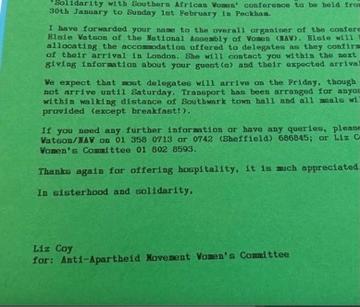
Figure 2: Letter template produced by the Anti-Apartheid Movement Women’s Committee, at the Conference on Solidarity with Southern African Women, 1987. Photograph taken by the author.
To provide another example, returning to the poster I included earlier [see Figure 1], it was produced to publicise a 1975 speaking tour by two women - Putuse Appolus, member of the Namibian Women’s League, and by a member of the South West Africa People’s Organisation (SWAPO), who travelled to Europe to form connections with the women there.[15] African women were therefore not only recognising the need for solidarity networks, but taking on direct roles in forming them. As importance is placed on connections with other women in both examples, the idea of a sisterhood across regions interested me. Sometimes this language of sisterhood was even explicitly used - in one 1987 conference, members signed off letters with “in sisterhood and solidarity” [see Figure 2].[16] In many ways, this sisterhood allowed women to express grievances specific to them. For example, one conference document stated apartheid policies separating families directly humiliated and oppressed women, showing how many women considered their oppression as mothers as inseparable from their oppression as women and people overall.[17]
A Singular Sisterhood?
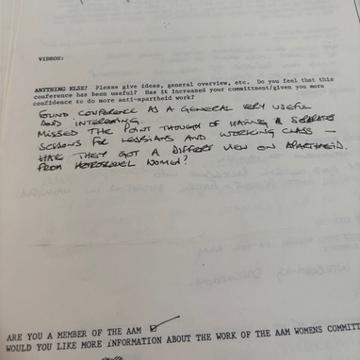
Figure 3: Conference feedback form from an attendee of the 1988 Women’s Dayschool in London, run by the Anti-Apartheid Movement Women’s Committee. Photograph taken by the author.
While I explored this notion of a global sisterhood, I also recognised I needed to be diligent to not romanticise these ideas while trying to ‘hear’ the voices of these women. In fact, the more I looked through the archives the more I began to problematise this notion of sisterhood. I found feedback forms where women disagreed about providing separate workshops for lesbians or working-class women only [see Figure 3].[18] Other women expressed concerns about not being able to commit to the cause as they had children they needed to take care of - a double burden that neither men nor some more privileged women faced. Clearly, not all women agreed on how their solidarity networks should operate, nor could they all equally participate. This cemented for me how solidarity was conceptualised very differently by different women, and thus how multifaceted ‘sisterhood’ was.
Having explored some of what the archives could tell me about women and their intellectual production, I considered something I could not find in physical records but was likely true – how many women, particularly non-white women would have been sceptical of the concept of a sisterhood itself? Given that many white women were complicit in upholding racist structures and apartheid in South Africa, it is understandable that black women would have been apprehensive about a ‘sisterhood’ with them.[19] For many, any feminism had to be intertwined with nationalism, anti-imperialism, and anticolonialism to bring meaningful change.[20]
Where Does Politics Take Place?
Accordingly, African women took on active roles in decolonisation, profoundly conscious of ideas of transnational solidarity, and keenly aware of the ways that different oppressive structures intersected and upheld one another. Many women sought to speak for themselves, presenting their own concerns (e.g., patriarchal oppression, childcare, motherhood as inseparable from personhood in some ways), beyond what masculinist nationalist projects were seeking, and likely beyond that of white feminist projects also. In directly establishing these links, these women brought the politics of their home (homeland and domestic space) to the world.
It is also important to recognise how extensive these networks were. For example, the 1985 International Conference on Women and Children under Apartheid, held in Tanzania, had female representatives from Egypt, Cuba, China, and Lesotho to name a few countries.[21] These were not the actions of one ‘exceptional’ woman; there were clearly manywomen – across Africa and across the broader Global South - operating in intentional, organised ways. Though, it was also a reality that it was mostly elite women who were able to participate.
Therefore, to challenge the implicit assumption that women, especially women from the Global South, do not or cannot engage in wider intellectual discussion, it is essential to recognise that change does not flow from masculine projects nor the West. It is crucial to question subconscious biases and assumptions of who does politics, and where in the world politics and change takes place.
Archive to Exhibition
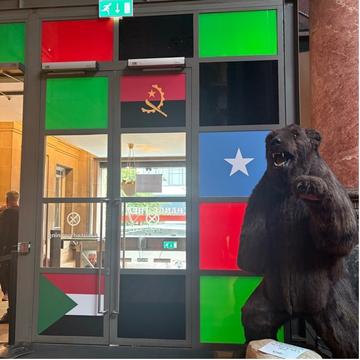
Figure 4: Royal Exchange Theatre during the performance of Liberation, 2025. Photograph taken by the author.
Having engaged with all these different quite abstract ideas, it posed a challenge trying to present this in a tangible material way for an exhibition. I visited different exhibitions to see how they presented complex information without losing important nuance [see Further Reading], and also saw the play Liberation.
Liberation, written by Ntombizodwa Nyoni, and directed by Monique Touko, is based on the 1945 Pan-African Congress in Manchester, exploring the internal dynamics of African and Caribbean activists fighting for independence. Even before seeing the play, I was immersed in the idea of different countries coming together as the venue was decorated with different African flags [see Figure 4]. The stage setup also brought the audience into the Congress itself, as many audience members were on the same level as the actors [see Figure 5]. As I was primarily researching conferences in relation to decolonisation, this experience was very useful in offering an example of how a conference might be made engaging and accessible to non-academic audiences.
The performance itself was also very moving. The play touched on so many of the themes I had been exploring; it showcased the sacrifices women had to make personally, but also how African women were ‘sacrificed’, minimised, and sidelined for the ‘sake of the movement’. The portrayal of the dynamic between Alma La Badie and Amy Ashwood Garvey particularly stuck with me. La Badie was a Jamaican social worker, and Ashwood Garvey a Jamaican Pan-Africanist, and they were the only two women who spoke at the actual conference. In one scene, after Ashwood Garvey is dismissed by the male activists, she warns La Badie: “They will never see you. They will never respect you. The first chance these men get, they will sacrifice you to make false gods of themselves”.[22] This was a very powerful presentation of what many of these women likely felt. In another scene, La Badie, having a disagreement with one of the men at the conference, declares “solidarity doesn’t mean I must be in community with everyone.”[23] This line perfectly captured much of what I had been researching - that forming solidarity networks did not result in an idealised harmonious movement.
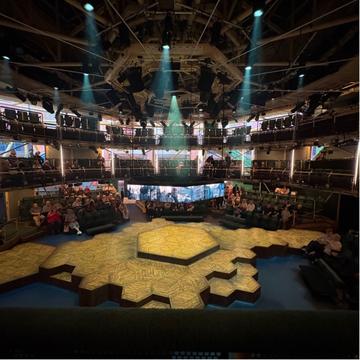
Figure 5: The Royal Exchange Theatre stage, 2025. Photograph taken by the author.
The playwright, Nyoni, in one interview, mentioned how she had to think more creatively for La Badie’s character as there were very few records on her.[24] These imagined scenes between the two women were therefore another way of dealing with the unknown in these women’s histories, another form of speculation and working around what the archives had silenced.
Conclusion: Thinking Beyond What We ‘Know’
In summary, over the course of my internship I tried, perhaps too ambitiously, to answer many different questions I had about navigating the unknown in the study of history; I sought to understand the inherent speculation, sensitivity required, and creativity within this. My intellectual history interest seeped into the project as I wanted to explore the knowledge production and intellectual exchanges of African women, and women more broadly. Throughout the process, I consistently questioned what I ‘know’ about African women and decolonisation, and how far what I ‘know’ was simply what I could ‘see’ – with what I ‘see’ often being what is deemed important knowledge from a Eurocentric or masculinist-nationalist perspective. It became clear that just because I could not ‘see’ the production of knowledge, that did not mean it did not occur, especially considering how the archive and nationalist narratives have marginalised many voices. Importantly, I also had to be careful to not romanticise these histories, or I would in fact be speaking over the voices I was trying to ‘hear’ from, reproducing this silencing in another way.
While providing some answers, this project has in fact raised many more questions for me about knowledge production, what constitutes ‘knowledge’, and the archive’s role within this. Who decides what is ‘worth’ recording and knowing and why? As the project comes to an end, my desire for more answers has not; I have been giving much thought to the unequal ways in which knowledge is created, accessed, and registered.
Bibliography
Primary sources
Anti-Apartheid Movement Women’s Committee, ‘Conference Feedback Sheet’, 1988, London. Bodleian Archives, Oxford – Anti-Apartheid Movement Collection – MSS AAM 349.
Anti-Apartheid Movement Women’s Committee, ‘Letter Template’, 1987, London. Bodleian Archives, Oxford – Anti-Apartheid Movement Collection - MSS AAM 348.
Namibia Support Committee, ‘SWAPO Women’s Tour Poster’, 1975, N. p., Bodleian Archives, Oxford – Anti-Apartheid Movement Collection – MSS AAM 2512/9/38.
United Nations Special Committee Against Apartheid, ‘Provisional List of Participants’, 1985, Tanzania, p. 4. Bodleian Archives, Oxford – Anti-Apartheid Movement Collection - MSS AAM 347.
United Nations Special Committee Against Apartheid, ‘Report of the International Conference on Women and Apartheid, Brussels 17-19 May 1982’, N.d. [c. 1985?], Brussels, p. 2. Bodleian Archives, Oxford – Anti-Apartheid Movement Collection – MSS AAM 347.
United Nations Special Committee Against Apartheid, ‘Report of the International Conference on Women and Apartheid, Brussels 17-19 May 1982’, N.d. [c. 1985?], Brussels, p. 11. Bodleian Archives, Oxford – Anti-Apartheid Movement Collection – MSS AAM 347.
Secondary Sources
‘po178. SWAPO Women’s Tour, 1975’ https://www.aamarchives.org/archive/goods/campaign-goods/po178-swapo-womens-tour-1975.html [accessed on 02/08/2025]
‘Talk #153 Zodwa Nyoni’ https://www.art.mmu.ac.uk/bunkertalks/talk-153/ [accessed on 18/09/2025]
Busia, Abena P. A., ‘Creating the Archive of African Women’s Writing: Reflecting on Feminism, Epistemology, and the Women Writing Africa Project’, Meridians 17(2) (2018), 233-245.
Enloe, Cynthia, Bananas, Beaches and Bases: Making Feminist Sense of International Politics (London: University of California Press, 2014).
Gradskova, Yulia, ‘Women’s International Democratic Federation, the ‘Third World’ and the Global Cold War from the late-1950s to the mid-1960s’, Women’s History Review 29(2) (2020), 270-288.
Hartman, Saidiya, ‘Venus in Two Acts’, Small Axe 12(2) (2008), 1-14.
Makana, Selina, ‘Motherhood as Activism in the Angolan People’s War, 1961-1975’, Meridians 15(2) (2017), 353-381.
Makana, Selina, Women in Nationalist Movements in Africa in Oxford Research Encyclopedias [online] https://doi.org/10.1093/acrefore/9780190277734.013.655 [accessed 23/07/2025]
McClintock, Anne, ‘“No Longer in a Future Heaven”: Women and Nationalism in South Africa’, Transition 51 (1991), 104-123.
Rupp, Leila, Worlds of Women: The Making of an International Women’s Movement (Princeton: Princeton University Press, 1997).
Salem, Sara, ‘Radical Regionalism: Feminism, Sovereignty, and the Pan-African Project’, Africa Development XLVII(1) (2022), 159-191.
Other
Nyoni, Ntombizodwa, Liberation (London: Methuen, 2025).
Further Reading
Gradskova, Yulia, ‘Women’s International Democratic Federation, the ‘Third World’ and the Global Cold War from the late-1950s to the mid-1960s’, Women’s History Review 29(2) (2020), 270-288.
Jayawardena, Kumari, Feminism and Nationalism in the Third World (London: Atlantic Highlands, 1986).
Rupp, Leila, ‘Challenging Imperialism in International Women’s Organisations, 1888-1945’, NWSA Journal 8(1) (1996), 8-27.
Rupp, Leila, Worlds of Women: The Making of an International Women’s Movement (Princeton: Princeton University Press, 1997).
Salem, Sara, ‘Radical Regionalism: Feminism, Sovereignty, and the Pan-African Project’, Africa Development XLVII(1) (2022), 159-191.
Yuval-Davis, Nira, and Floya Anthias, Woman-Nation-State (Cambridge: Palgrave Macmillan, 1989).
Exhibitions
‘Unsilenced: Sexual Violence in Conflict’ at the Imperial War Museum, London
‘Women of the World Unite: The United Nations Decade for Women and Transnational Feminisms 1975 to Now’ at the London School of Economics Women’s Library
[1] Abena P. A. Busia, ‘Creating the Archive of African Women’s Writing: Reflecting on Feminism, Epistemology, and the Women Writing Africa Project’, Meridians 17(2) (2018), 233-245 (233-236).
[2] Busia, ‘Creating the Archive’, 239.
[3] Saidiya V. Hartman, ‘Venus in Two Acts’, Small Axe 12(2) (2008), 1-14 (11-12).
[4] Hartman, ‘Venus in Two Acts’, 12.
[5] Selina Makana, ‘Motherhood as Activism in the Angolan People’s War, 1961-1975’, Meridians 15(2) (2017), 353-381 (360-362).
[6] Makana, ‘Motherhood as Activism’, 354-355.
[7] Namibia Support Committee, ‘SWAPO Women’s Tour Poster’, 1975, N. p., Bodleian Archives, Oxford – Anti-Apartheid Movement Collection – MSS AAM 2512/9/38.
[8] Cynthia Enloe, Bananas, Beaches and Bases: Making Feminist Sense of International Politics (London: University of California Press, 2014), p.82.
[9] Selina Makana, ‘Women in Nationalist Movements in Africa’ in Oxford Research Encyclopedias, pp.1-2 [online] https://doi.org/10.1093/acrefore/9780190277734.013.655 [accessed 23/07/2025]
[10] Leila Rupp, Worlds of Women: The Making of an International Women’s Movement (Princeton: Princeton University Press, 1997).
[11] Sara Salem, ‘Radical Regionalism: Feminism, Sovereignty, and the Pan-African Project’, Africa Development XLVII(1) (2022), 159-191.
[12] Yulia Gradskova, ‘Women’s International Democratic Federation, the ‘Third World’ and the Global Cold War from the late-1950s to the mid-1960s’, Women’s History Review 29(2) (2020), 270-288.
[13] United Nations Special Committee Against Apartheid, ‘Report of the International Conference on Women and Apartheid, Brussels 17-19 May 1982’, N.d. [c. 1985?], Brussels, p. 2. Bodleian Archives, Oxford – Anti-Apartheid Movement Collection – MSS AAM 347.
[14] United Nations Special Committee Against Apartheid, ‘Report of the International Conference on Women and Apartheid, Brussels 17-19 May 1982’, N.d. [c. 1985?], Brussels, p. 5. BA, Oxford – AAMC – MSS AAM 347.
[15] ‘po178. SWAPO Women’s Tour, 1975’ https://www.aamarchives.org/archive/goods/campaign-goods/po178-swapo-wom... [accessed on 02/08/2025]
[16] Anti-Apartheid Movement Women’s Committee, ‘Letter Template’, 1987, London. Bodleian Archives, Oxford – Anti-Apartheid Movement Collection - MSS AAM 348.
[17] United Nations Special Committee Against Apartheid, ‘Report of the International Conference on Women and Apartheid, Brussels 17-19 May 1982’, N.d. [c. 1985?], Brussels, p. 11. BA, Oxford – AAMC – MSS AAM 347.
[18] Anti-Apartheid Movement Women’s Committee, ‘Conference Feedback Sheet’, 1988, London. Bodleian Archives, Oxford – Anti-Apartheid Movement Collection – MSS AAM 349.
[19] Anne McClintock, ‘“No Longer in a Future Heaven”: Women and Nationalism in South Africa’, Transition 51 (1991), 104-123 (110).
[20] Enloe, Bananas, Beaches, and Bases, pp. 97-98.
[21] United Nations Special Committee Against Apartheid, ‘Provisional List of Participants’, 1985, Tanzania, p. 4. Bodleian Archives, Oxford – Anti-Apartheid Movement Collection - MSS AAM 347.
[22] Ntombizodwa Nyoni, Liberation (London: Methuen, 2025), pp.57-58.
[23] Nyoni, Liberation, p. 43.
[24] ‘Talk #153 Zodwa Nyoni’ https://www.art.mmu.ac.uk/bunkertalks/talk-153/ [accessed on 18/09/2025]