

The London Private Banker: A Social History, 1660-1825
In his latest book, Perry Gauci examines the societal impact of the London private bankers as they established a significant metropolitan presence between 1660 and 1825.
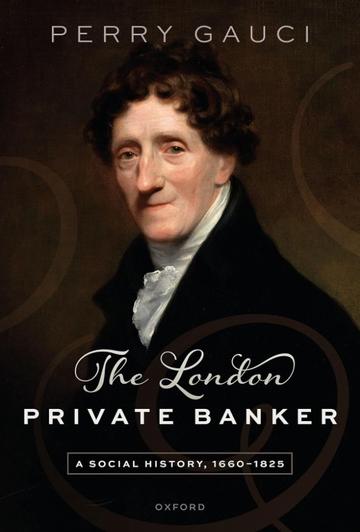
I first became interested in London’s private bankers some thirty years ago, and this book reflects many of the social and cultural themes of my earlier work. Building on excellent research on the economic importance of the sector, The London Private Banker demonstrates how the commercial role of the retail bankers can illuminate an array of dynamic social forces in eighteenth-century Britian, especially the relationship between the middling and upper orders. Their experiences highlight the distinctive foundations of the British social order, and the book tracks their importance through their commercial services, public lives, and private pleasures.
The study is structured to highlight their wide-ranging connections and their reliance on their social reputation. The first four chapters focus on the private banker at work, identifying the core sample of 300 banking partners active across the long eighteenth century. In the late Stuart period, the sector was often volatile, but the mid-Georgian period saw greater stability as public confidence grew in both the bankers and the services they provided. The historic associations of the trade with usury were slow to dissipate, but by the later eighteenth century a private banking sector had emerged as a significant feature of urban Britain, to the extent that partners could be regarded as establishment figures, lauded or vilified in turn for their contribution to national prosperity or instability.
While focused on the private banking partner, the book also explores the character of the banking-house and the daily workings of the banker’s “shop”. Inspired by excellent recent scholarship on the architecture of the banks, this study examines relations between partners, staff, and customers, to highlight the emergence of a banking culture of service. Although discretion remained a watchword for bankers, the banking premises represented a semi-public space, and both the shop and its staff could communicate reassuring messages to customers and wider audiences. City private bankers worked with fellow businessmen of similar outlook, but they still faced challenges when monitoring the accounts of commercial customers. Bankers in the West End faced such difficulties too, but they also had to construct durable relationships with their social superiors. Excellent banking sources highlight how the concept of “friendship” helped them to bridge social divisions, and bankers at both ends of town developed these connections to maintain and expand their business. In this way, they came closest to adopting the “professional” characteristics of the law and medicine, although without imperilling their reputation for commercial probity.
This heightened societal profile is explored in the last three chapters, which examine the social and political strategies used by private bankers to communicate core messages about their durability and public service. Given the importance of reputation to their businesses, private bankers often required political skills and connections. In the later Georgian period, there was a notable increase in the numbers of banker-MPs, and their impact at Westminster and Whitehall highlighted their growing societal influence. In turn, the development of the banking sector inevitably led to greater public scrutiny, engendering often-bitter discussions of their role in state and society. From the attacks on the goldsmith-bankers in the Restoration period to the anguished cries for banking regulation in the wake of the financial crashes of 1772 and 1825-6, they were under constant pressure to prove their public worth. The volatility of the sector did not help it to secure its reputation, but by the later eighteenth century a more persuasive defence of the private banker was advanced as a well-connected and useful citizen. Nonetheless, nineteenth-century banking reforms were needed to re-build public trust and to preserve the essential respectability of this commercial profession.
Taken together, leading banking houses such as Child, Hoare, and Coutts represented a remarkably successful social phenomenon, whose wide-ranging influence ranked alongside the metropolitan merchants and the early industrialists. Nonetheless, they still offered little challenge to the ruling landed orders, finding common cause with their social betters during the revolutionary turbulence of the later Georgian era. The private bankers did not represent a threat to the social pre-eminence of the aristocracy and gentry either. Extensive philanthropy and membership of elite institutions allowed many bankers to mix in gentle circles, but their social advancement rested on their ability to mirror landed values without losing their reputation for commercial responsibility. In a business dedicated to projecting continuity and stability, their domestic arrangements were often a mirror of their professional lives, where longevity and dynastic stability were celebrated as reflections of inner commercial virtues.
On a more personal note, this book has proved one of my enjoyable historical adventures, for surviving banking archives allowed me to study the commercial and landed classes through first-hand exchanges, often at a level of surprising intimacy and friendship. I have rarely come across such rich sources, and they helped me to understand the subtle interplay of societal forces working for both change and continuity. As many readers will quickly recognize, the book owes a great debt to the work of Paul Langford, especially his classic Polite and Commercial People.

