2026 Annual George Rousseau Lecture: "Poland was but a breakfast": or, why 1772 helps us to understand 1776
David Armitage (Harvard University)
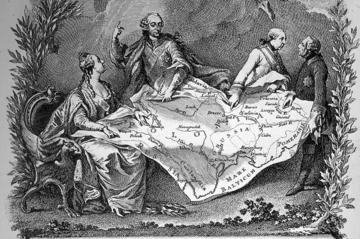
Allegory of the 1st partition of Poland, Wikimedia Commons
The American Revolution is now widely accepted to have been the last civil war within the British Empire of the Atlantic world. However, British, imperial, and Atlantic contexts do not exhaust the historical frames essential to understand the Revolution or, more specifically, 1776. For contemporaries on both sides of the Atlantic, Europe—particularly the European balance of power—was the most important setting for the fears raised by the American War. The greatest assault on that balance of power had occurred only four years before 1776 in 1772 with the first Partition of Poland by Austria, Prussia and Russia. This lecture shows how fears of partition, "Poland like", drove the decision for American independence and how the Polish response to partition shaped the British counterblast to the Declaration of Independence.
The lecture will be followed by a drinks reception.
David Armitage is the Lloyd C. Blankfein Professor of History and former Chair of the Department of History at Harvard University, where he teaches intellectual history and international history. He is also an Affiliated Professor in the Harvard Department of Government, an Affiliated Faculty Member at Harvard Law School, and an Honorary Professor of History at the University of Sydney. Before coming to Harvard in 2004, he taught for eleven years at Columbia University. He is the author or editor of fifteen books, among them The Ideological Origins of the British Empire (2000), The Declaration of Independence: A Global History (2007), Foundations of Modern International Thought (2013), The History Manifesto (co-auth., 2014), and Civil Wars: A History in Ideas (2017). Among his edited works are Shakespeare and Early Modern Political Thought (co-ed., 2009), The Age of Revolutions in Global Context, c. 1760-1840 (co-ed., 2010), and Pacific Histories: Ocean, Land, People (co-ed., 2014).

