
Bloodsuckers of the Commonwealth: Monopolies, petitioning and the public sphere in early modern Engl
Ellen Paterson
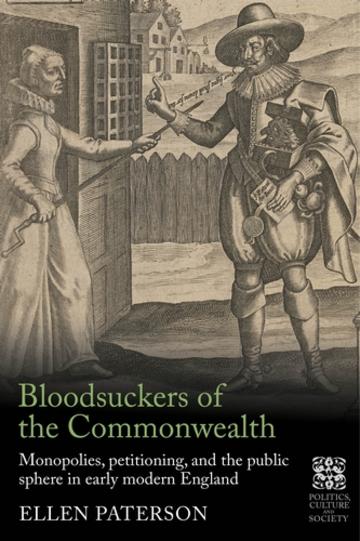
I’m delighted that my first monograph, Bloodsuckers of the Commonwealth: Monopolies, petitioning and the public sphere in early modern England (Manchester, 2025) was longlisted for the 2026 Royal Historical Society First Book Prize. Bloodsuckers provides the first in-depth analysis of anti-monopoly petitioning activity in late Elizabethan and Jacobean England (1590-1625), arguing for the importance of economic issues for mobilising subjects in a pre-revolutionary public sphere.
The book focuses on the impact of the crown’s fiscal policies on the political behaviour and views of a range of subjects in early modern England. Both Elizabeth I and James VI and I faced acute financial shortages, triggering them to use new fiscal devices to raise revenues. This included patents of monopoly, which were granted over a variety of trades and industries. The holders of these grants (many of whom were courtiers) were awarded the sole rights to manufacture and retail certain goods or were given powers to supervise entire industries. Monopolies were granted over a range of products, including salt, wine, and leather. One MP in the Commons in 1601 sarcastically asked ‘is not bread there?’ during an anti-monopoly debate, an utterance which reflected the growing alarm in the political nation with the proliferation of monopolies throughout the realm.
In order to gauge the reaction of ordinary subjects to this crown policy, Bloodsuckers focuses on one key source material: manuscript petitions. As people throughout England were forced out of their trades or made to pay for licences to continue to use them, many turned to this ancient form of communication to make their grievances known to such centres of authority as the Privy Council, Parliament, and even the Crown. The book traces various petitioning campaigns throughout myriad archives, utilising the account books and court records of London’s various livery companies, which became key spaces for the organisation of collective petitioning protest. The book also shows the ways in which the boundaries between what constituted a legitimate grant versus a monopolistic patent became blurred in this period. Thus, despite being holders of their own charters and trading privileges, London’s livery companies and overseas trading corporations became entangled in monopoly protests, presenting their rivals as agents of monopoly whilst defending themselves as necessary bodies for the ordering and regulation of trade. Charges of monopoly became an important weapon as interest groups battled through dialogic petitioning campaigns.
Bloodsuckers is organised into five key chapters which are organised both thematically and chronologically, focusing on petitions directed to different centres of political authority. The first chapter begins by introducing the issues of charter and monopoly in the late sixteenth and early seventeenth centuries, demonstrating the ways in which groups of artisans and merchants requested royal charters to incorporate new companies in an age of corporatism. Chapter 2 focuses on anti-monopoly agitation in the city of London, showing the ways through which the lord mayor and court of aldermen examined and protested proposals for new monopolistic grants throughout the 1590s. Chapters 3-5 turn to James’s reign. Chapter 3 examines petitions to the city and the royal court soon after James’s accession in 1603, as the realm eagerly hoped that the arrival of a new king would bring an end to the monopoly policy of his predecessor. They were to be sorely disappointed. Chapter 4 focuses on anti-monopoly petitioning campaigns to Parliament. The fifth and final chapter ends in the 1620s, a period of a European-wide economic depression, analysing the ways through which clothiers and cloth workers utilised the erection of new investigative commissions for trade to protest the monopoly rights of one of the realm’s most important companies, the Merchant Adventurers.
Bloodsuckers enhances our understandings of the processes of petitioning in the early modern past, a topic which has become increasingly popular amongst historians. By following petitioning campaigns through the archives, it enhances our understandings of the processes by which subjects met in taverns and guildhalls to pen petitions, hired and funded legal counsel, or travelled to the halls of Westminster to voice their concerns before MPs and peers. The book also reflects more broadly on what these cases can tell us about the politicisation of non-elite subjects in the early modern past. Perhaps its most important finding is that the intrusions of patentees and crown agents on subjects’ lives caused them to reflect on broader issues of political import. As they petitioned to protect their livelihoods, subjects commented on the relationship between the crown’s royal prerogative and their common law liberties, the mechanisms through which trade should be regulated, and the power and place of parliament in the nation. As subjects entered Westminster to testify before such bodies as the Commons’ Committee for Grievances, they were exposed further to parliamentary news and debates, encounters which I show were key for shaping their perception of such institutions. And whilst James was anxious to avoid the discussion of ‘matters of state’ by what he termed the ‘vulgar’ sort, his approach to economic policy making reflected a growing awareness that the consultation of a wider remit of artisans and merchants was necessary to devise policies. Bloodsuckers therefore argues for the importance of monopoly for drawing a range of subjects into negotiations with state authorities, processes which were key for their incipient political thinking.
Perhaps most importantly, Bloodsuckers argues for the need for historians to continue to explore the ways through economic issues served as a major driver for political debate at the turn of the seventeenth century. Historians have done much to show us the importance of religious and constitutional struggles in the lead up to the Civil Wars, regarding this as a key driver of public discussion in an early modern ‘public sphere’. However, the sheer intensity with which subjects’ protested monopolies and mobilised to protect their trades serves to remind us that, then as now, economic realities are fundamental for shaping political behaviour.
- Ellen Paterson