

Association for Art History - 2025 DISSERTATION PRIZE WINNERS
Xintong Cindy Liu, a BA History of Art graduate has been awarded the Association for Art History thesis prize 2025
The Department of History of Art and the Faculty of History are proud to announce that Xintong Cindy Liu, a graduate of our BA programme in 2025, has been awarded the thesis prize for that year by the Association for Art History for her dissertation 'Picturing Your Body, Imag(in)ing Your Place: Japanese Imperial Postcards of Women Entertainers in Manchuria.’ She received her award during a ceremony held at the University of Cambridge.
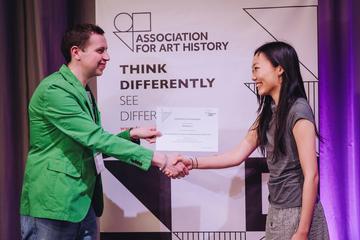
Xintong Cindy Liu receiving her award during a ceremony held at the University of Cambridge
Combining close visual and materialist analysis, my thesis examines a body of 1930s Japanese imperial postcards of women entertainers in Manchuria as both coded images and complex hybrid objects. The Japanese postcard boom in the early twentieth century coincided with the empire’s imperial expansion into its Asian neighbors: the empire generated not only nationalist pride and expansionist dreams that fueled their supply and demand, but also the material foundation that enabled their mass production and circulation. As both an affordable means of mass communication and attractive collectible souvenirs, postcards depicting the landscapes, peoples, and customs in the newly occupied lands proliferated, among which were postcards of women entertainers. Analyzing and comparing postcards of Chinese and Russian women entertainers, my thesis argues that they participated actively in the construction of modernity, place, and identity of Manchuria, and embodied the deep imbrication of imperialism, nationalism, and capitalism in Japan’s enunciation of power over the contested borderland. Manchuria was imagined at once as a nation and imperial outpost, East-Asian and Western, traditional and modern. These postcards of women entertainers in Manchuria occupy a central though concealed position in Japan’s imperial project and epitomize the contradictory and ambivalent identity of this contested region.
My project responds to the lacuna of research focused on these commercial imperial postcards of Manchuria, as well as the general amnesia of Japanese imperialism in decolonial and postcolonial discourses. The thesis first examines the epistemic structure of the postcard medium and position them materially in the imperial-capitalist matrix of Japanese imperialism in northeastern Asia. Specific postcards are then analyzed to examine how representations of women’s bodies embodied Manchuria’s ambivalent modernity and how they were coded into the construction of an imaginative geography. These cards shaped an imperial dream of Manchuria and sold it through the tourist industry, in which the boundaries between capital and empire, imagination and reality, modernity and tradition were transgressed and contested.
Some feedback from the selection committee:
“An original and well-structured study of Japanese imperial postcards of women entertainers in Manchuria. Strong engagement with visual and material analysis, situating the postcards within imperial, capitalist, and touristic networks. The close readings capture the ambivalence of modernity, gender, and empire, and the argument flows logically from introduction to conclusion.”
“This is an original, well-researched and critically analysed essay. Focused on postcards depicting Chinese and Russian women entertainers and their use in the construction of modernity, place and identity in 1930’s Manchuria. References are effectively used to develop the author’s ideas, and their choice of research methodology is appropriated executed. Key terms, such as ‘women entertainers’ are defined and allow for what the author describes as a ‘crucial lens on the picture: gender’… Their chapter on the postcard as a ‘a body of “related and contextualised visual documents”, gives a useful context to the close analysis of the chosen images. While there are many examples of the author’s skill in drawing the viewer into your discussion, I found chapter three particularly arresting, for instance the author’s analysis of Figure 17 and observation of the way women entertainers were inextricably linked with cities, for instance Dalian and Fengtian. A reminder of the pictorial tradition of equating the female body with territorial conquest.”
I am tremendously grateful for the guidance and support of my supervisor, June and Simon Li Professor J.P. Park, as well as my tutors Professor Geoffrey Batchen at the Department of History of Art and Professor Jane Garnett at Wadham College. In my research process, I have also consulted various researchers in related fields, whose expertise and generosity were incredibly helpful. These include Philip Grover, Senior Assistant Curator of Photograph, Film, and Sound Collections at the Pitt Rivers Museum, and Professor Norman Smith at the University of Guelph, Canada.
I’m currently reading MSc Digital Scholarship at Oxford, funded by the Clarendon Scholarship. My research interests include digital colonial archives, ethics of care in digitizing sensitive/violent materials, historical narratives and critical fabulation.
- Xintong Cindy Liu

