Learning to listen to my grandmother
By Naima El Halili Kintlerova
Oral history, as Alessandro Portelli argues, has the potential to spotlight groups “whose history is absent or distorted from the written record”, especially those who were illiterate.1 This potential has made the use of oral history crucial in “recovering” histories of women, particularly African women. The African tradition of oral transmission of history, coupled with high illiteracy rates, has meant that African histories are oftentimes lost due to archival biases towards written records. Thus, oral testimonies allows for these histories to be recovered and reinserted into historical narratives. Furthermore, oral history provides an opportunity for women, particularly “ordinary” and illiterate women, to re-claim their agency by challenging dominant colonial and nationalist narratives which often distort, or entirely exclude, women. Moreover, as Portelli points out, the content of oral history often focuses on daily life.2
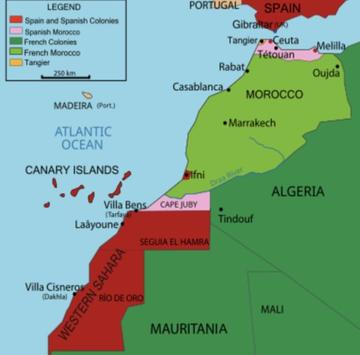
Keen to utilise oral history, I decided to interview my grandmother, Fatima Laabi. My grandmother, born in 1939, lived under the Spanish Protectorate (1912 – 1956) in a North Moroccan rural village called Rhona near the city of Larache. Enacting the Spanish Protectorate, the 1912 Treaty of Fes divided Spanish and French spheres of influence and established them as protectorates. Whilst the French Protectorate oversaw central and Southern Morocco, the Spanish Protectorate took control of Northern Morocco. Although quite young during the colonial years, I hoped to get a sense of my grandmother’s experiences as a rural Moroccan woman under colonial governance. However, as I would discover, the process of collecting oral histories is not one without complications.
Prior to the call with my grandmother, I had a conversation with my father and aunt in which I discussed the project and my objectives for the interview. They initially questioned whether my grandmother could provide me with any useful information on life under colonial rule. Not only was our region under the Spanish Protectorate which, they remarked, did not overtly interfere with the local population, my grandmother was also a rural woman who had limited direct interaction with Spanish administration and troops. This demonstrated how dominant and masculinised narratives of decolonisation and nationalism dictated understandings of politics and resistance. Labelling the women and the home as apolitical, these narratives affected both historical narratives and personal memory.
Oral history provides an opportunity to challenge these assumptions by uncovering the ways in which dominant narratives and women’s lived experiences diverge and converge. These dominant nationalist narratives often highlight the exceptional role of women such as Princess Lalla Aicha, who called for the mobilisation of women through education in her speeches, and Malika El Fassi, the only woman to sign the Independence Manifesto in 1944 – an Istiqlal Party (Independence Party) document which called for Morocco’s independence.3 It was their education and prominent social position which allowed for these exceptional women to participate in public politics and thus preserve their place in nationalist narratives. By contrast, women’s roles in urban resistance movements, which varied from carrying messages and arms to washing and cooking for fighting men, are reduced to “support” roles and resultingly undermined in dominant narratives.4 Far removed from the political life and armed resistance in urban areas, rural women are almost entirely excluded from nationalist narratives. This exclusion highlights how historical narratives have privileged male-dominated and urban forms of anti-colonialism, such as political parties and armed resistance, whilst ignoring every day and rural resistance. It was the desire to challenge this exclusion, rooted in the assumption of rural women and the home as apolitical, which further motivated me to interview my grandmother.
One of my first considerations was who was to be present during the interview. Here, both methodological and practical concerns guided my choices. Despite Valerie Yow’s general recommendation for the presence of only the interviewer and interviewee,5 I chose to have my aunt and father present. I was worried that if I was to conduct the interview on my own, I would impose myself as a formal interviewer, creating hierarchies and imposing barriers between me and my grandmother. The presence of my aunt and father, I hoped, would create a comfortable and informal environment resembling any other conversation we would have sitting around the living room. Moreover, my aunt, familiar with my grandmother’s experiences, could remind her of things she may have forgotten to mention. Simultaneously, practical considerations were a significant factor in my decision to have my father present. My grandmother and aunt only speak darija (Moroccan Arabic) whilst my father and I speak both English and darija. Although I am fluent in darija, I was aware that my comprehension may be lacking regarding terms associated with the colonial period. The presence of my father ensured I completely understood my grandmother and could therefore conduct the interview more effectively.
Aware that my grandmother may not consider her experiences as anti-colonial, I began by asking broader questions to allow her to speak more freely. Although I was particularly interested in the prevalent North African tradition of storytelling through song and poem, starting broadly would allow me to better understand her life as a rural woman and identify any other promising avenues of research.
My initial questions asked of her experiences growing up in Rhona, what her daily routine and chores involved, how often she visited the city and what differences she observed. The initial simple answers my grandmother provided - “life was good, but we were poor” - underscored the importance of learning to listen and probing. I had to listen carefully to her answers, picking out the right follow up questions based on the answers she provided, or more importantly did not provide.
In her reflections on interviewing rural women in Washington, Kathryn Anderson notes that, focused on ‘producing potential material for the exhibit’ she was working on, she may have not listened as deeply to narrators’ responses and consequently missed out on opportunities to allow these women to fully explore aspects of their life experiences.6 This resonated with my experience interviewing my grandmother.
Despite approaching the interview with an open mind, at times my particular interest in songs and poems sung by women in everyday settings, led me to not question certain answers beyond face value. For example, when I first asked if the Spanish soldiers were ever violent, my grandmother remarked “No, never!” She, before talking of the violence in the jbel, the neighbouring region, explained that many soldiers who passed through her village, some undergoing training nearby, would exchange clothes and shoes for food. However, my next question, “When and how often did you go into the city?” quickly changed the topic, not allowing for further elaboration. In hindsight, I wish I interrogated this interaction as it stood in stark contrast with other violent encounters between the Moroccan population and the Spanish troops in the Rif and jbel.
Much of oral interviews depends on picking up the subtle and unspoken, such as body language, which can crucially dictate meaning. Commenting on her interviews, Anderson recalled how her and her fellow interviewers noted discrepancies between the transcripts and their recollections of the interview as the meaning was conveyed ‘through intense vocal quality and body language.7 Thus, solely relying on verbal cues, I was challenged to listen carefully.
The methodological challenges I encountered highlighted how an interview is co-produced by interviewer and interviewee, with complex dynamics shaping what and how information is shared. Being an “insider” - being a Moroccan woman and her granddaughter – allowed my grandmother to speak more freely due to our shared identity and the absence of formalities. Yet, similarly to Akemi Kikumura’s position when collecting her mother’s life story, cultural and generational differences positioned me as an “outsider.”8 My grandmother’s and my experiences differed significantly; I grew up in England and in Larache, a Moroccan city, during the twenty-first century. Rather than constituting as a disadvantage, this position meant that my grandmother and aunt took time to explain contexts more fully, circumventing the issue of interviewees assuming that an “insider” is already aware of certain experiences.9 My dual position highlighted how an interviewer is rarely a complete “insider” or “outsider.” Rather, the information shared during the interview is usually a negotiation between interviewer and interviewee shaped by the interplay of complex identities.
Most strikingly, both my grandmother and aunt did not mention songs and poems until I asked about them despite them being a part of everyday life in rural Morocco from childhood to adulthood. Children would be gathered at night around a fire and one of the elders would narrate a story. Women, working the fields together, would sing songs everyday about varying topics including love, religion, trips to the market, and social issues. Leaving out these songs from my grandmother’s description of daily life is indicative of how interviewees often mute crucial aspects of their experience in order to offer information which they believe to be relevant. My grandmother and my aunt, aware that I was researching themes of colonialism and decolonisation, ignored such a paramount dimension of their lived experiences – storytelling – as it did not fit the dominant understanding of politics and anti-colonialism. This, again, highlighted the importance of exploring songs as a way to re-define politics and challenge the divorcing of the home and personal from political, often associated with direct resistance and violence.
As Shirli Gilbert points out, music is accessible to everyone as it requires no musical training or literacy and could be conducted anywhere.10 It is this accessibility and potential of music to illuminate the histories of groups overlooked by conventional narratives, which ultimately sideline illiterate populations, that makes the use of music, in any form, as a historical source crucial. This is especially relevant to my grandmother’s case as songs were, as well as a key aspect of everyday life, a way for women to communicate their lived realities, even if they did not themselves recognise the political dimension of their experiences.
Although my grandmother talked in detail about what they sang about and the context in which they did, when I asked her to sing any song which she could remember, she was hesitant to share them and remained quiet. These songs, sang daily, would have been inscribed in my grandmother’s memory; it is unlikely that she forgot all of them. Most likely, the presence of a male figure, her son, could have made her hesitant to share these songs which were sang in exclusively female spaces. Alternatively, she may have been reluctant to sing due to the number of people present. Thus, although having my father and aunt present facilitated an informal setting and ensured understanding, perhaps a more intimate interview would have been a better choice. This would have allowed my grandmother to feel more comfortable to disclose these songs and share more about her gendered experiences as a rural Moroccan woman.
Despite this, my aunt provided me a song which she remembers being sung by my grandmother. This song was sung from the perspective of a woman who ran away to join the resistance and left her family behind. I have included this song below:
سامحيني الوحيدة...مشيت بلا منعلمك
Forgive me al-Wahida...I left without letting you know
نصراني دخل نبلاد...و انا ماش للجهاد
The Christian entered the homeland...and I'm going to Jihad
انا ندافع على عرضي و بلادي...وانا خليت لك ولادي
I'm going to defend my honour and homeland...and I entrusted my children to you
سامحيني يايما...رانا وهبت دمي و روحي نبلادي يسمحيني يايما وارضي عليا
Forgive me Mother...I gave my blood and soul to my homeland forgive me mother and bless me
Through the content, language, and context it was sang in, this song highlighted how women perceived resistance to be a deeply personal matter as opposed to political. By singing songs like this, rural women directly reflected and shaped anti-colonial sentiments and, consciously or not, their individual and collective identity as anti-colonial women. Thus, making use of oral history and songs is a way to re-insert women into dominant narratives which, by masculine and Eurocentric standards, are labelled as apolitical, excluding them from anti-colonial and nationalist history.
Interestingly, songs were themselves recognised as essential in the nation-building projects by nationalist leaders. In his efforts to mobilise support for the United Arab Republic (UAR), a pan-Arab state grounded in a shared Arab identity, Egyptian President Gamal Abdel Nasser made great use of the Voice of Arabs radio station. The radio station, positioning itself as a force of Arab unity and anti-colonialism, played songs which echoed these sentiments and soon became an anti-colonial voice across the Arab world.11
Most notably, Umm Kulthum, a singer that anyone from an Arabic-speaking country is familiar with, was heavily featured on the station. Alongside her more famous love songs, Umm Kulthum significantly contributed to the shaping of Arab nationalist identities through her songs, the most notable example being والله زمان يا سلاحي (Wallah Zeman Ya Selahi). Translating to “It has been a long time, Oh my weapon!”, the song, a call to arms and emphasising resistance and sacrifice, was played up to ten times a day on the radio during the 1956 Suez Canal Crisis and was adopted as the national anthem of the UAR in 1960.12
https://www.youtube.com/embed/u3F8kFMM0cE?si=G-tO4MY1Ni_B77an
Similarly, in Lebanon, Fairuz, another legendary Arab singer, contributed significantly to the crafting of Arab and Lebanese nationalism. Through her more emotional songs such as the نسم علينا الهوى (Nasam ‘Alain al-Hawa), in which she speaks of longing to return to her homeland, she crafted a more emotional and personal nationalism which contrasted more formal and militant nationalisms. This resonated across the Arab world.
Hence, publicly and privately, women contributed to decolonisation processes through the medium of songs. The active role of Umm Kulthum and Fairuz in the public sphere has memorialised them, rightfully so, in dominant narratives due to their ability to publicly mobilise nationalist sentiments. However, when crossing over into the private sphere, songs which reveal much about women’s relationship with concepts like decolonisation and nationalism are neglected due to the supposedly apolitical context in which they occur. It is worth noting that these famous songs were often written and composed by men for nationalist purposes. Among many others, Umm Kulthum’s songs were written by Bayram al-Tunisi, a famous poet who was exiled by the British for his Egyptian nationalist poetry. Fairuz, on the other hand, would work closely with the Lebanese artists, the Rahbani brothers throughout her career, later marrying Assi Rahbani. I do not mention this as a way of undermining Umm Kulthum and Fairuz’s agency and roles, but rather to highlight the way in which songs made by women in exclusively female spaces are overlooked.
The exclusionary definition of politics also enacts archival silences. When doing further research, acknowledging that I was using British archives which would naturally hold less material on colonial North Africa, I broadened my search for songs to the African continent. Even then, I could only find a few records of songs related to resistance movements in general, much less those produced by women and in private. This emphasises the importance of oral history as it provides a voice for marginalised groups to reassert themselves in narratives which exclude them.
Overall, the interview and research process was both academically and personally rewarding. The process highlighted the significance of oral history in spotlighting histories sidelined by conventional narratives whilst making me aware of the challenges of conducting oral history. On a more personal level, I had the opportunity to learn more about my grandmother’s experiences as a young rural Moroccan woman and share at least a fragment of her story. I would encourage everyone to question their biases around what politics constitutes and where it takes place, and to have a conversation with their family members. Even if you do not think that your relatives fit the conventional mould of “political” and “revolutionary”, their stories are often political and revolutionary in their own right.
- Alessandro Portelli, ‘The Peculiarities of History’, History Workshop (Oxford University Press; 1981) p.97
- Ibid., p.97
- Alison Baker, Voices of resistance: Oral Histories of Moroccan Women. (State University of New York Press; 1998) p.69
- Ibid., p.166
- Valerie Yow, ‘Interviewing Techniques and Strategies” in The Oral History Reader ed. By Robert Perks and Alistair Thomson (Taylor & Francis Group; 2015). p.154. ProQuest Ebook Central.
- Kathryn Anderson and Dana C. Jack, ‘Learning to Listen: Interview Techniques and Analyses’ in Women’s Words: The Feminist Practice of Oral History ed. By herna Berger Cluck and Daphne Patai. (Taylor & Francis Group; 1991). . p.19. ProQuest Ebook Central
- Ibid., p.18
- Akemi Kikumura, ‘Family Life Histories: A Collaborative Venture’, The Oral History Review (Taylor & Francis Ltd; 1986) p.4 <https://www.jstor.org/stable/3674779>
- Amy Tooth Murphy, ‘Listening, listening out’, Oral History (Oral History Society; 2020) p.39 <https://www.jstor.org/stable/10.2307/48568046>
- Shirli Gilbert, ‘Music as Historical Source: Social History and Musical Texts’, International Review of the Aesthetics and Sociology of Music (Croatian Musicological Society; 2005). p.119 <https://www.jstor.org/stable/30032162>
- Jala Ts Selmi and Mehemet Rakipoğlu, ‘The Role of Radio and Umm Kulthum’s Voice in Spreading Nasserite Arab Nationlism.’ (Akademik Incelemeler Dergisi; 2023) p.250 <https://doi.org/10.17550/akademikincelemeler.1310286>
- Amuna Wagner, ’Umm Kulthum and Gamal Abdel Nasser, the voice of the Arabs.’ (2023) <https://pan-african-music.com/en/umm-kulthum-gamal-abdel-nasser/>