
Dr Jennifer Altehenger

Associate Professor of Chinese History, Jessica Rawson Tutorial Fellow in Asian History
Merton College
jennifer.altehenger@history.ox.ac.uk
I research and teach the history of modern and contemporary China in its global contexts. Prior to joining the History Faculty, I was Senior Lecturer in Contemporary Chinese History at King's College London and an An Wang Postdoctoral Fellow at Harvard University's Fairbank Center for Chinese Studies. I am series co-editor of the Cambridge Studies in the History of the People's Republic of China (Cambridge University Press), and Transformations of Modern China (De Gruyter), and Associate Editor of the journal Modern China. A few years ago I also edited 'The Mao Era in Objects', a website for anyone who would like to learn about the history of modern China and the Mao period (1949-1976) through interactive biographies. The project was funded by an AHRC leadership fellowship and designed by King's College Digital Lab. At Oxford, I am an affiliate of the Oxford China Centre and the Oxford Centre for Global History.
Research Interests
- Material culture, industry, and design
- Cultural production and propaganda
- Socialist law and civic education
Most of my current work examines the history of design and industry in China after World War II. China today is one of the world's major furniture producers and a global manufacturer of materials used to make everyday objects. The material environments of people living in the UK, Europe, and other regions of the world are entangled with the lives of those working in Chinese design and industry. Yet we know little about the contemporary history that led to China's prominent position in global furniture manufacturing and design. My book -- Socialism by Design: How Mass-Produced Furniture Modernized China (under contract with Princeton University Press) – will tell the stories of people who helped materialise modern China in urban coastal as well as interior cities, and internationally: as designers and producers in research institutes, state offices, factories, communes, and individual homes; as traders across the capitalist and socialist world; and as users who altered objects, furnished interiors, and found creative solutions in times of material shortage. The project has received funding from the Arts and Humanities Research Council, the British Academy, and a Leverhulme Trust Research Fellowship. As part of this research, I have written on the history of design magazines, trade exhibitions, housing design, bamboo objects, and furniture standards and standardization. Together with Dr. Denise Ho (Yale University), I edited Material Contradictions in Mao's China (2022) and I am co-editor of the volume, How Maoism Was Made, with Prof. Aaron W. Moore (University of Edinburgh) for the Proceedings of the British Academy (2025).
I also continue to maintain an interest in the history of law and civic education in state socialism. My book Legal Lessons: Popularizing Laws in the People's Republic of China, 1949-1989 (Harvard Asia Centre/Harvard University Press, 2018) shed light on China's history of state-led mass legal education, from the early years of the People's Republic into the first decade of 'reform and opening' after Mao Zedong's death in 1976. Asking not whether laws were successfully implemented but how they were communicated and to what effect, the book demonstrated that educating the general population in laws has been a crucial, if controversial, component of Chinese Communist Party governance. Laws, in other words, are central to understanding Chinese socialist statecraft during a period often thought of as 'lawless'.
Publications
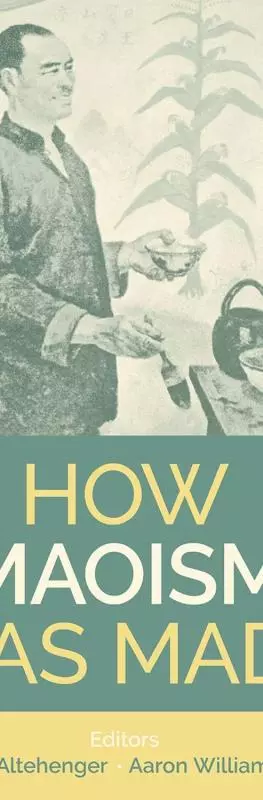
How Maoism was Made: Reconstructing China, 1949-65
(Oxford: Oxford University Press/Proceedings of the British Academy, 2025)
With Aaron W. Moore
How Maoism Was Made focuses on the history of the early years in China after 1949, featuring new scholarship by academics across Europe and North America. The field of early PRC history has been transformed by the unprecedented accessibility of archives from the 1990s to the early 2010s. Nineteen contributors show how the revolutionary system was built and maintained by the efforts of non-elite actors, including scientists, farmers, designers, artists, cadres, and ordinary citizens. By abandoning the Cold War political work of vilifying or celebrating Chinese communism, How Maoism Was Made aims to render the history of the Maoist system comprehensible to specialists and non-specialists alike, by viewing it through the lens of people who made it. Chinese communism is revealed to be a set of beliefs and practices that inspired millions of people to (re-)build their country and find a new life within it.
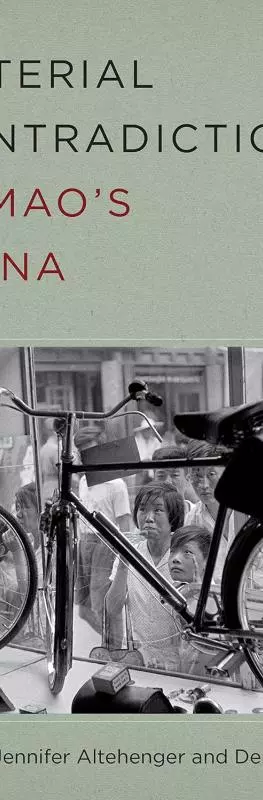
Material Contradictions in Mao’s China
With Denise Y. Ho
An excavation of the sociocultural, economic, and political history of everyday commodities
The growth of markets and consumerism in China’s post-Mao era of political and economic reform is a story familiar to many. By contrast, the Mao period (1949–1976)—rightly framed as a time of scarcity—initially appears to have had little material culture to speak of. Yet people attributed great meaning to materials and objects often precisely because they were rare and difficult to obtain. This first volume devoted to the material history of the period explores the paradox of material culture under Chinese Communist Party rule and illustrates how central materiality was to individual and collective desire, social and economic construction of the country, and projections of an imminent socialist utopia within reach of every man and woman, if only they worked hard enough.
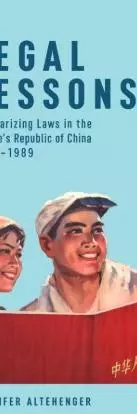
Legal Lessons: Popularizing Laws in the People’s Republic of China, 1949–1989
(Cambridge, MA: Harvard University Press/Harvard University Asia Center, 2018)
The popularization of basic legal knowledge is an important and contested technique of state governance in China today. Its roots reach back to the early years of Chinese Communist Party rule. Legal Lessons tells the story of how the party-state attempted to mobilize ordinary citizens to learn laws during the early years of the Mao period (1949–1976) and in the decade after Mao’s death.
DPhil Students
I would like to hear from potential DPhil and Masters Students who want to write on the social and cultural history of twentieth-century China, the history of the People's Republic of China, the history of material culture, materiality and design, and the transnational history of Chinese state socialism.
In the Media
- Yale & Oxford Professors on Material Contradictions in Mao’s China -
Yale Center Beijing YouTube - Material Contradictions in Mao’s China - National Committee on U.S.-China Relations YouTube
- Q&A about my book Legal Lessons - Association of Asian Studies Website