
Life and Death in Tudor Prisons

An exciting new research project from the Oxford History Faculty

News
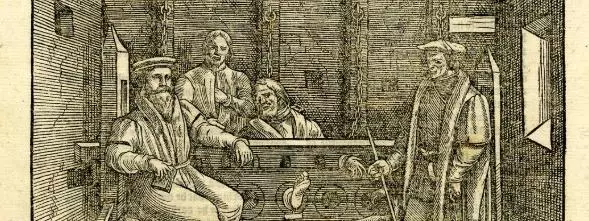
A prison cell, with one man in the stocks, three other men standing or sitting, and a dog chewing on a bone; illustration to page 1418 of a 16th-century edition of John Foxe, 'Acts and Monuments' ('Book of Martyrs').

Professor Steven Gunn and Dr Tomasz Gromelski are leading a new research project, funded by the AHRC Curiosity Award scheme, which aims to transform our patchy understanding of Tudor imprisonment.

Working with a number of heritage sites across the country, the project seeks to ask who was in prison, why they were there, and how, other than execution, they died.

At present there are good accounts of the life of the London prisons, where traitors and religious dissidents joined metropolitan debtors and moral offenders. Yet remarkably little is known about the great mass of prisoners, held for everyday crimes – theft, murder, witchcraft – or for debt in county, town and episcopal gaols.

Using around 9,000 coroners’ inquests, which supply details of illnesses and deaths during imprisonment, the project aims to reframe scholarly and popular understanding of Tudor imprisonment. Working with Dr Leah Astbury of the University of Bristol it will also ask what light death in prison sheds on the health of the wider Tudor population.

The heritage partners with whom the team will work to present the findings to visitors include Oxford Castle, where the research will feed directly into programming for the 20th anniversary of the site’s opening to the public, and Lincoln Castle. A project advisory board, including senior representatives from Norwich Castle Museum and Art Gallery and English Heritage, will ensure the research has wider heritage sector reach and impact.

Emily Denmark, Operations Duty Manager at Oxford Castle & Prison, said

The research will contribute to a deeper understanding of the site’s heritage and history, and shape future narratives. This is especially meaningful as Oxford Castle & Prison marks 30 years since the prison’s closure and 20 years since opening to the public.

Cllr Natalie Oliver, executive councillor for culture at Lincolnshire County Council, said:

I am thrilled that Lincoln Castle has been chosen as one of just a handful of heritage partners to contribute to this groundbreaking University of Oxford research project. Lincoln Castle operated as a prison for more than 900 years, but we know very little about the offenders that served time there before the current prison was built in 1788. Who were they? Where did they come from? What crimes did they commit? This exciting project has the potential to transform our understanding of how the castle was used in the Tudor period, helping us to tell more chapters of the monument's incredible story.

The project is supported by and developed with Dr Rachel Delman in the Divisional Heritage Partnerships team.

What is the Curiosity Award scheme?

The AHRC Curiosity Award scheme offers flexible awards to fund fundamental research that leads to new research agendas.

Life and Death in Tudor Prisons is the first Curiosity Award success for the Humanities Division at The University of Oxford.

News

The role of the lay elite in the development of early medieval Christian kingship

“Far beyond the ken of the pedagogue”? Tracing the fight for scientific authority in nineteenth and twentieth century “child study”

Julia Gustavsson is a DPhil candidate in the Faculty of History at St Peter’s College, Oxford, supervised by Prof Christina de Bellaigue and Dr Alex Aylward. Her doctoral research focuses on the historical practices of research on children in the UK through exploring the so-called child study movement which originated in the late nineteenth century.

Specialist interventions, family strategies and the lives of London’s disabled children, 1880-1918

Rachel O’Driscoll is a DPhil candidate in the Department for Continuing Education and at Kellogg College, University of Oxford. Her fields of interest include the history of disability, education, welfare and childhood in nineteenth and twentieth century Britain.

Gender Dynamics and Feminist Intervention in Youth Clubs in Late Twentieth-Century England

Ryan Aslett has just finished his second year studying Geography at the University of Exeter, Cornwall. He will spend the following year studying at Radboud University in the Netherlands. He is interested in how modern-day austerity has impacted young people's spatialities, social spheres and holistic development.

Who was the Schools Action Union For?

Shona Roberts is a recent University of Reading History and Politics Graduate, with a keen interest in the development of social and political movements.

Generations and cohorts, adults and children

Dr Laura Carter is an historian of modern Britain whose work focuses on histories of education, gender, and social change. Her first book, Histories of Everyday Life: The Making of Popular Social History in Britain, 1918-1979 (OUP, 2021) was nominated for the Royal Historical Society Whitfield Book Prize, 2022

The Internationalisation of Midland Bank: Edward Holden and Correspondent Banking Relations in the United States and Canada (1891-1919)

Post-Mortem by Print: Reflections on the Death of Lucius Cary, 2nd Viscount Falkland

Mapping Global Banking Networks in the Early Twentieth Century: Banks with Correspondent Connections to London (1901-1913)

Blind Children in Late Ottoman Istanbul: A Glimpse through Education and Welfare Policies

İrem Yıldız is a DPhil candidate in the Faculty of Asian and Middle Eastern Studies at St. Antony’s College, Oxford. Her fields of interest include the history of disability, medicine, childhood studies, and museum studies in the nineteenth and twentieth centuries Ottoman Empire and the Middle East.

Dr. Henry Hammond and the Allestree Library

“One gold child’s bracelet”: Traces of Children in Stolen Property Documents from the Holocaust in Hungary

Barnabas Balint is a doctoral candidate at the University of Oxford under the supervision of Dr Zoe Waxman. His multi-lingual research (in English, French, and Hungarian) combines the history of childhood, gender, and identity, to explore Jewish responses to persecution.