Professor Rob Iliffe

Professor of the History of Science
Linacre College
robert.iliffe@history.ox.ac.uk
Rob Iliffe is Professor of History of Science at Oxford, a General Editor of the Newton Project, and director of the Koch History Centre. He is the author of A Very Short Introduction to Newton (OUP 2007) and Priest of Nature: the Religious Worlds of Isaac Newton, (OUP 2017), and co-editor of The Cambridge Companion to Isaac Newton, 2nd ed. (CUP, 2016). He was editor of History of Science from 2001-8 and co-editor of Annals of Science from 2010-19.
He has published widely on topics in the history of early modern and Enlightenment science, and particularly on historical interactions between science and religion, scientific voyages of discovery, the life and work of Isaac Newton, the development of ideas about scientific genius and scientific creativity, and the role of scientific instruments in scientific innovation.
At Oxford he teaches general Undergraduate course on history of science and technology courses as well as more specialized courses on the Scientific Revolution, the history of modern physics, and the history of scientific racism and eugenics. At Postgraduate level he teaches courses on the Scientific Revolution, and on Evolution and Neo-Malthusianism from 1840 to 1970.
Topics being studied by Professor Iliffe's DPhil (PhD) students over the last decade include: agronomy in eleventh and twelfth-century al-Andalus; the development of notational symbols in alchemy 1400-1700; astronomy and timekeeping in the Ummayad mosque under Mamluke rule; utopian techno-scientific ideals in Europe from 1500-1700; shifting notions of the Alkahest 1580-1720; the master-disciple relationship in heliocentric astronomy 1550-1720; Samuel Hartlib’s transatlantic world; theology and the chronological research of Isaac Newton; the growth of the mathematical book trade in England 1570-1700; Swedenborg’s conception of the soul-body relation; representations of philosophical/scientific genius 1720-1860; the British patent system and the emergence of the expert witness, 1760-1800; science, geology and ceramics in the career of Alexandre Brongniart 1785-1840; medicine and the development of eugenics in England, 1870-1920; the scientific and religious thought of Kang Youwei, 1880-1925; the development of Virtual Reality technology in the United States 1965-2005; British cybernetics, 1946-58.
Research Interests
My research interests lie within the following headings:
- environmental history
- digital humanities/digital history
- The work of Isaac Newton
- The global spread of the exact sciences 1700-1840
- material culture and science
- historical relations between science and religion
- interactions between science and science fiction
Publications
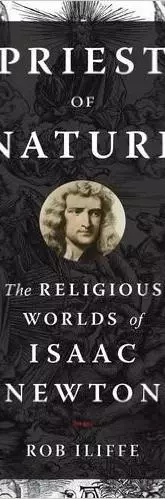
Priest of Nature: The Religious Worlds of Isaac Newton
Newton's unusual — or even downright heretical — religious opinions were well known to a number of his contemporaries. For over two centuries the exact nature of his religious beliefs was a matter of intense debate, but by the middle of the nineteenth century it was public knowledge that he had held highly unorthodox conceptions of the Trinity. Until the early 1970s, very few of Newton's private theological researches had been made publicly available, and scholars did not determine his views with any precision.
DPhil Students
I would like to hear from potential DPhil students in any areas of my research interests (see under Research)
In the Media
- 8 November 2018 - Inaugural Lecture: Science Fictions: The triumph of the imagination and the invention of scientific creativity - In this lecture Prof Iliffe will describe the various attacks on the imagination launched by natural philosophers in the seventeenth century, and account for the dramatic change in its reputation that occurred in the middle of the eighteenth century, when a powerful imagination became the defining characteristic of the recently-invented scientific genius.
- 20 June 2017 - 'Making History' - Stukeley and Stonehenge - Tom Holland is joined by Rob Iliffe, Professor of the History of Science at the University of Oxford and Dr David Haycock the author of ‘William Stukeley: Science, Religion, and Archaeology in Eighteenth-century England - BBC Radio 4
- 18 Feb 2016 - Melvyn Bragg and guests discuss the life and work of Robert Hooke (1635-1703) - In our Time