Dr Marilena Anastasopoulou

Departmental Lecturer in Modern European History
Christ Church
marilena.anastasopoulou@history.ox.ac.uk
I am a Departmental Lecturer in Modern European History in the Faculty of History and at Christ Church, University of Oxford. I am also a Research Associate at South East European Studies at Oxford (SEESOX) and the Hellenic Observatory Centre (HOC) at the London School of Economics and Political Science (LSE). My interdisciplinary research explores how migration shapes memories, identities, and attitudes in modern Europe.
My monograph, A Century of Asia Minor Refugees in Greece: Flight, Fight, and Fraternity (Oxford University Press, 2026), is a comparative history of Asia Minor memories and identities of forced displacement, both intergenerational and interregional. It examines the multilayered relationship between contemporary attitudes and the refugee past. My new book project, ‘Everyday Diasporas and Global Experiences’ (EDGE), advances a theory of horizontal integration based on migrant-to-migrant interaction on the margins of European history.
My work has been funded by UK Research and Innovation (UKRI), the Economic and Social Research Council (ESRC), and the Onassis Foundation. It has received several awards, including the Best Doctoral Paper Award of the Association for the Study of Nationalities (ASN) World Convention, Columbia University, 2021.
I hold a DPhil in History and an MSc in Migration Studies from the University of Oxford. I was previously a Visiting Fellow at Yale University’s MacMillan Center, Assistant Professor of Migration History at University College Dublin, Postdoctoral Fellow at the LSE and Oxford, and an award-winning Lecturer at Oxford.
Publications
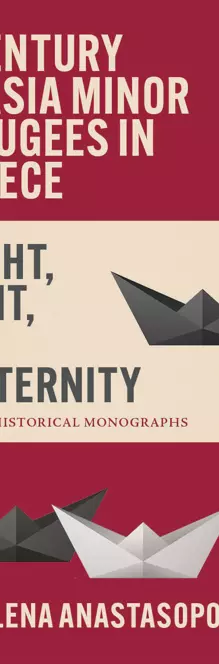
A Century of Asia Minor Refugees in Greece: Flight, Fight, and Fraternity
This book is a comparative—intergenerational and interregional—history of Asia Minor memories and identities of forced displacement that examines the multilayered relationship between contemporary attitudes and refugee past. Marking the centenary of the Asia Minor population transfer in the context of Greece’s contemporary migration crisis, the research questions that this book addresses are: how have memories of the 1922–24 forced displacement changed over time from one generation to the next? How do people with these memories and identities think about subsequent migration? Following a regional history approach and an oral history approach, this study draws upon literature from several disciplines and rests upon oral testimony. Specifically, it employs a methodology of collecting primary sources using oral testimonies (262 life history interviews) and archival evidence (five thousand oral testimonies) based on three regional case studies, namely the borderland island of Lesvos, Central Macedonia in northern Greece, and Attica. This book argues that refugee identity is a capacious and dynamic platform of ongoing understanding as well as a limited space of domination and competition. Elucidating the attitudes of refugee descendants and unfolding key patterns about the complex role of refugee memory and identity, it brings together the intersection of three interlocking elements: time (refugee generations), place (refugee locations), and subsequent migration (waves of other migrations). In short, A Century of Asia Minor Refugees in Greece sheds light on the convoluted relationship between contemporary attitudes and refugee past, providing a nuanced history of the 1922–24 memories and identities of forced displacement.