Dr Haig Smith

Teaching Fellow in Early Modern European and Global History
I am a historian of early modern Europe and the wider world, with particular interests in religion, commerce, empire and the movement of people and ideas between Europe and Asia. Much of my research has focused on overseas companies and missionary organisations, and on the ways they became involved in governing communities as well as trading, travelling and proselytising.
At Oxford, I teach early modern European and global history. I have previously taught at Manchester, Liverpool and Greenwich. My teaching interests include the Reformation and religious change, European overseas expansion, empire and colonialism, the history of capitalism and political economy, South Asia and the Indian Ocean, migration and mobility, and encounters between European and non-European societies.
Research Interests
- Early modern Europe
- The Indian Ocean world
- Overseas companies and corporate governance
- Religion, commerce and political economy
- Missionary organisations
My research is interested in how the early modern world was connected, and in the institutions that made those connections possible. I work across European and global history, with a particular focus on the movement of people, money, information and religious ideas between Europe and Asia.
A lot of my work has focused on overseas companies. I am interested in what happened when organisations set up to trade found themselves having to govern. Companies such as the English East India Company had to make decisions about worship, law, discipline, labour, migration and relations between different communities. Those decisions were shaped not only by European ideas, but by negotiation with local rulers, merchants, religious groups and competing European powers.
South Asia has been central to much of this research because it makes those relationships especially visible. In places such as Bombay and Madras, Europeans were only one group among many, and their authority was often limited, negotiated and dependent on local circumstances. Looking closely at these settlements opens up broader questions about how political power worked in the early modern world.
I am also interested in the relationship between religion and political economy. Company officials often treated religious accommodation in practical terms, linking it to the attraction of merchants, artisans and labourers and to the growth of towns and trade. My current project, Missionary Corporations and the Moral Economy of Protestantism: Scotland, England, Denmark and Empire, 1696–1854, takes these questions beyond commercial companies. It looks at missionary organisations as institutions with their own finances, employees, networks and political ambitions, and asks how religion became tied to changing ideas about commerce, improvement, labour and empire.
More broadly, I am interested in comparative and connected approaches to early modern history, especially work that moves between Britain, continental Europe, South Asia and the Indian Ocean rather than treating them as separate worlds.
Publications
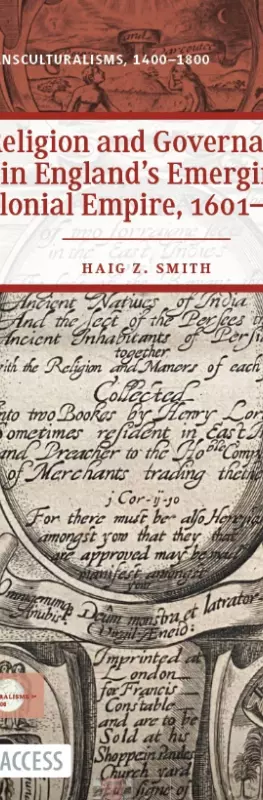
Religion and Governance in England’s Emerging Colonial Empire, 1601–1698
This book explores the role of religion in the development of England’s overseas companies and early colonial government. Drawing on the East India, Virginia, Massachusetts Bay, Plymouth, New England and Levant Companies, it shows how these organisations used different forms of religious governance to regulate their employees and the diverse communities that came under their authority. In doing so, it argues that religion was central to the development of corporate government and the seventeenth-century foundations of English imperial rule.