

Dr Antonio Pattori
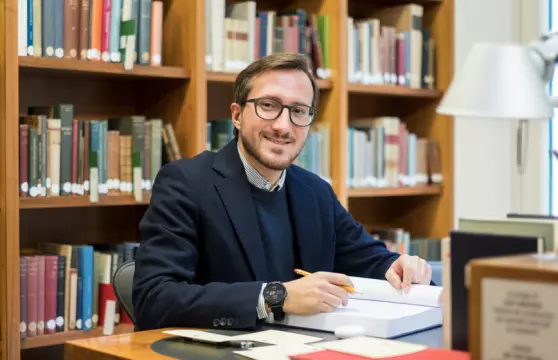
Postdoctoral Associate Member
antonio.pattori@history.ox.ac.uk
Leave to Supplicate Granted: November 2026
My research to date has primarily centred around sixteenth-century conspiratorial politics, and their wider transnational political, cultural, and diplomatic role. My DPhil, entitled 'Cultures of Conspiracy in Sixteenth-Century Italy', examines how information was mobilised during the Italian Wars (1494–1559). I argue that conspiracies were a systematic, recognised form of political action, deployed by foreign powers to weaken their rivals’ allies, but also shaped by local, intellectual, social, and religious elements that permeated a far wider cross-section of society than the narrow circles closest to power.
I am an Associate Member at the Faculty here in Oxford, as well as a Rome Fellow at the British School at Rome, where I am working on a post doctoral project on the destruction of the city of Castro by Pope Innocent X (1649). I completed my DPhil in History at University College, Oxford (2023-2026), following an Mst in Early Modern History at New College, Oxford (2022-2023), and a BA in History at St Hugh's College, Oxford (2019-2022).
Research Interests
I am a political and cultural historian of early modern Europe, with particular focus on Renaissance Italy. Though my doctoral research focused primarily on Italy, I am also interested in cultural and diplomatic interconnections across the entirety of Europe, particularly between Italy, Tudor England, and Valois France. Some of my published and forthcoming work has centred around the fall of Thomas Cromwell (1540), the trial and execution of the Earl of Surrey (1546-47), and Henry VIII's attempts to have Cardinal Reginald Pole assassinated.
I am the co-convenor of the Early Modern Diplomacy Seminar (c.1400-1800). For more information, or to present a paper, please email me. I also co-lead an interdisciplinary and comparative project on early modern cryptography. Along with mathematicians and Digital Humanities experts, we use digital methods to compare the effectiveness of encoding practices employed by different European states, as well as to reconstruct lost cypher keys and break cyphered diplomatic correspondence.
The Sacrifice of Thomas Cromwell
Antonio Pattori, and Susan Brigden
The arrest of Thomas Cromwell in June 1540 and his inescapable execution on 28 July offered a chance for the Catholic powers of Christendom to hope and work for the end of the English schism. In 1540, Charles V proposed colloquies between the different confessions in his empire and in the same spirit conceived an alliance with Henry VIII. Both Charles and Henry practised to deceive, but two mysterious Imperial missions to England in July 1540, which the removal of Cromwell made possible, and the manner of Henry’s welcome of them, provide proof of the seriousness of their intent. The brief period between Cromwell’s arrest and his death was exploited by both Henry VIII and European powers to attempt reconciliation, or, at least, to temporize. This article analyses complex diplomatic reports to show how Cromwell’s fall assumed significance far beyond England, as new evidence of an abrupt realignment at a climacteric of European dynastic politics and Reformation diplomacy reveals.