Dr Anna Ross

Associate Professor and Fellow and Tutor in Modern European History
Balliol College
I research and teach the history of modern Europe, particularly Central Europe and its global entanglements. Prior to joining the History faculty, I was Associate Professor of Modern European History at the University of Warwick. I am co-editor of the journal German History(CUP) and one of three editors of the Cambridge Elements book series, Global Urban History.
Research Interests
I’m interested in the 1848 revolutions, state-building, empire (both the Hohenzollern and Habsburg Empires), interwar Germany and Austria, and internationalisation. My first book, Beyond the Barricades: Government and State-Building in Post-Revolutionary Prussia, 1848–58, (OUP, 2019), re-evaluated the response of Prussian conservatives to the 1848 revolutions. I continue to be interested in the 1848 revolutions and have recently extended this work with others in the volume, State-Making in an Age of Revolution, 1830–1880 (Proceedings of the British Academy, 2025).
My current work explores imperial collapse at the end of the First World War (see, for example, ‘Navigating Post-Imperial Transitions after the First World War: Introduction’, Contemporary European History, 34 (2025): 1201–1211). I am writing a monograph on spaces of suspended state-making in this world of transition, following the lived experiences of a whole range of people caught up in what came to be known as international zones. This work is funded by an AHRC Research Grant (Imperial Afterlives) carried out with Dr Jean-Michel Johnston (University of Cambridge). It also intersects with work I have been conducting on the internationalisation of Tangier, and more broadly, Spain’s swan song of colonial engagement in North Africa (funded by the British Academy).
Publications
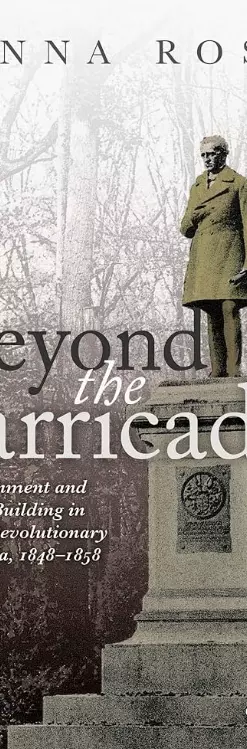
Beyond the Barricade
Government and State-Building in Post-Revolutionary Prussia, 1848–58
(OUP, 2019)
Beyond the Barricades is an original study of government after the 1848 revolutions. It focuses on the state of Prussia, where a number of conservative ministers sought to learn lessons from their experiences of upheaval and introduce a wave of reform in the 1850s. Using extensive archival research, the work explores Prussia's entry into the constitutional age, charting initiatives to transform criminal justice, agriculture, industry, communications, urban life, and the press. Reform strengthened contact with the Prussian population, making this a classic episode of state-building, but Beyond the Barricades seeks to go further. It makes a case for taking notice of government activity at this particular juncture because the measures endorsed by conservative statesmen in the 1850s sought to remove the feudal intermediaries that had lingered long into the nineteenth century and replace them with an array of government institutions, legal regimes, and official practices. In sum, this book recasts the post-revolutionary decade as a period which saw the transition from an old to a new world, pivotal to the making of modern Prussia and ultimately, modern Germany.
DPhil Students
I welcome enquiries from potential DPhil and Masters Students on any aspect of the German Empire, Habsburg Empire, interwar histories of Germany or Austria, urban history, and/or themes related to internationalisation in the modern era.