Dr Achille Marotta
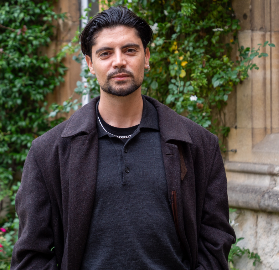
Sir John Elliott Junior Research Fellow in History
Oriel College
achille.marotta@history.ox.ac.uk
Achille holds a PhD in Global History, Politics, and Culture from the University of Bologna, where he defended a thesis on slavery and Muslims in the Republic of Genoa during the seventeenth and eighteenth centuries. Before that, Achille completed a bachelor’s in social anthropology at the London School of Economics and a master’s in development studies at SOAS, University of London. After his PhD, Achille was a Max Weber Fellow at the European University Institute in Florence. Achille’s research has also been funded by the Luigi Einaudi Foundation (Turin) and the Renaissance Society of America.
Research Interests
Achille is a historian of the early modern Mediterranean, with a particular focus on relations between the Italian peninsula and the Ottoman Maghrib. His research deals with the institution of captivity that enslaved millions of people in the Mediterranean between 1500 and 1800, and the entanglements that it created between Christian and Islamic societies. He is especially interested in how this history can unsettle our current understanding of the state, kinship, citizenship, and identity.
Achille’s work has been deeply influenced by the Italian and French microhistorical tradition, its critical use of sources, and the important contributions it has made to the history of power, property, and local belonging in the ancien régime. The microanalytical approach has brought Achille to focus especially on the port city of Genoa during the seventeenth and eighteenth centuries, and more recently on Tunis.
Although Achille primarily works on Italian-language sources such as petitions, notary deeds, and court records, he has analysed Arabic-language deeds and chronicles in his recent work. In addition to this, Achille’s current research deals with the use of art objects as sources in microhistory. In all these aspects, his work is deeply influenced by ethnographic approaches to theoretical issues, particularly those emanating from the anthropology of kinship and the anthropology of art.
The Muslim Friend: Cross-Confessional Male Intimacy in Eighteenth-Century Italy
Journal of Early Modern History 28, no. 3 (2024): 230–52.
In early modern Italy, stereotypes about Muslim men’s supposed inclination towards the vice of ‘sodomy’ gave rise to fears that Christian masculinity was being tainted. Eighteenth-century court records from the Republic of Genoa and the Papal States contain numerous instances of cross-confessional male relations that faced persecution by state authorities. In each of these cases, Christian men were prosecuted for taking a sexually ‘passive’ role in relation to sexually ‘active’ Muslims, while the reverse scenario was never pursued. This article argues that the sexual focus of judicial authorities obscured the enduring bonds of affection and mutual obligation that developed between men across religious lines. The existence of these relationships unveils an intimate sphere of connections across faith in the early modern Mediterranean while highlighting an intersectional site of Christian social anxiety, where fears of religious contamination overlapped with concerns about same-sex intimacy.