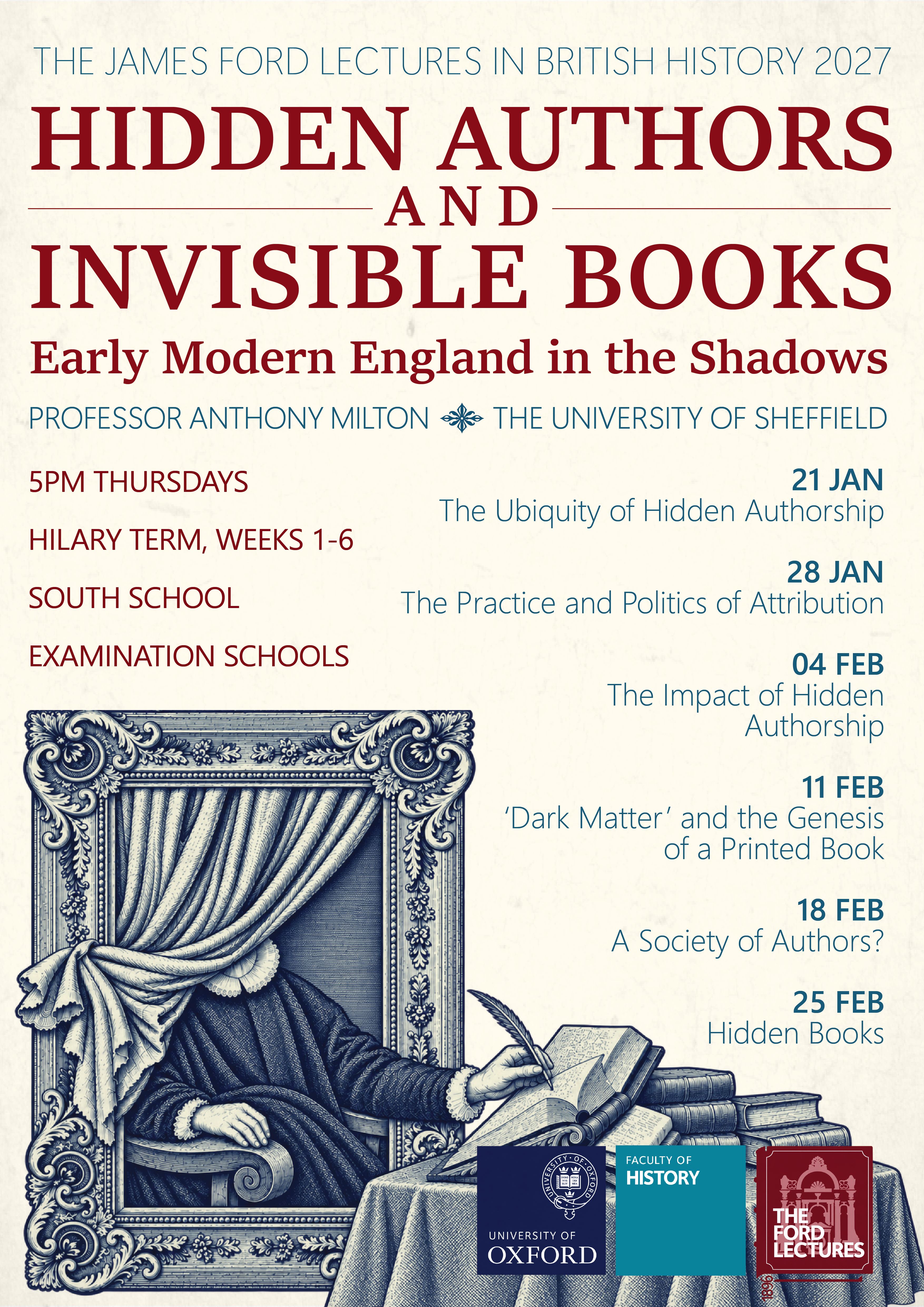

The James Ford Lectures in British History 2027
The Practice and Politics of Attribution
28 January 17:00 | South School, Examination Schools
Professor Anthony Milton (University of Sheffield)
Attribution can often be regarded as merely the solution to a modern bibliographical puzzle or inconvenience. But how and why and with what success did contemporaries attribute works of hidden authorship to individual writers, and how were these identifications collected, disseminated and (finally) established? This lecture attempts to address these questions through analysis of changing attributions of authorship of selected texts. It also explores the activities of several scholars who sought to provide systematic attributions with varying success and rigour. Attribution and misattribution, we will see, could have their own politics which can still create traps for the unwary historian.
About the series
Hidden Authors and Invisible Books: Early Modern England in the Shadows
The mindset of early modern England can seem literally an open book when we contemplate the more than 146,000 printed titles available on the Early English Books Online (EEBO) database for the period 1473-1700. Yet this was also an age of acute textual ambiguity, when a substantial proportion of printed texts appeared either without an author’s name, or with a false or misleading one. Moreover, this was a time when an avalanche of books and other composed texts were devised and/or composed which cannot be found on EEBO, but which nevertheless often crucially shaped the nature and meaning of the printed texts that we can access. These lectures will explore the myriad ways in which authorial identities were hidden, declared, misconstrued and forgotten during this period, and the implications of this for how contemporaries and later historians have read and understood texts. They will also consider the many forgotten writers and ‘invisible’ texts which can help challenge our assumptions of what it meant to be an ‘author’ and to compose a ‘book’ in this period.