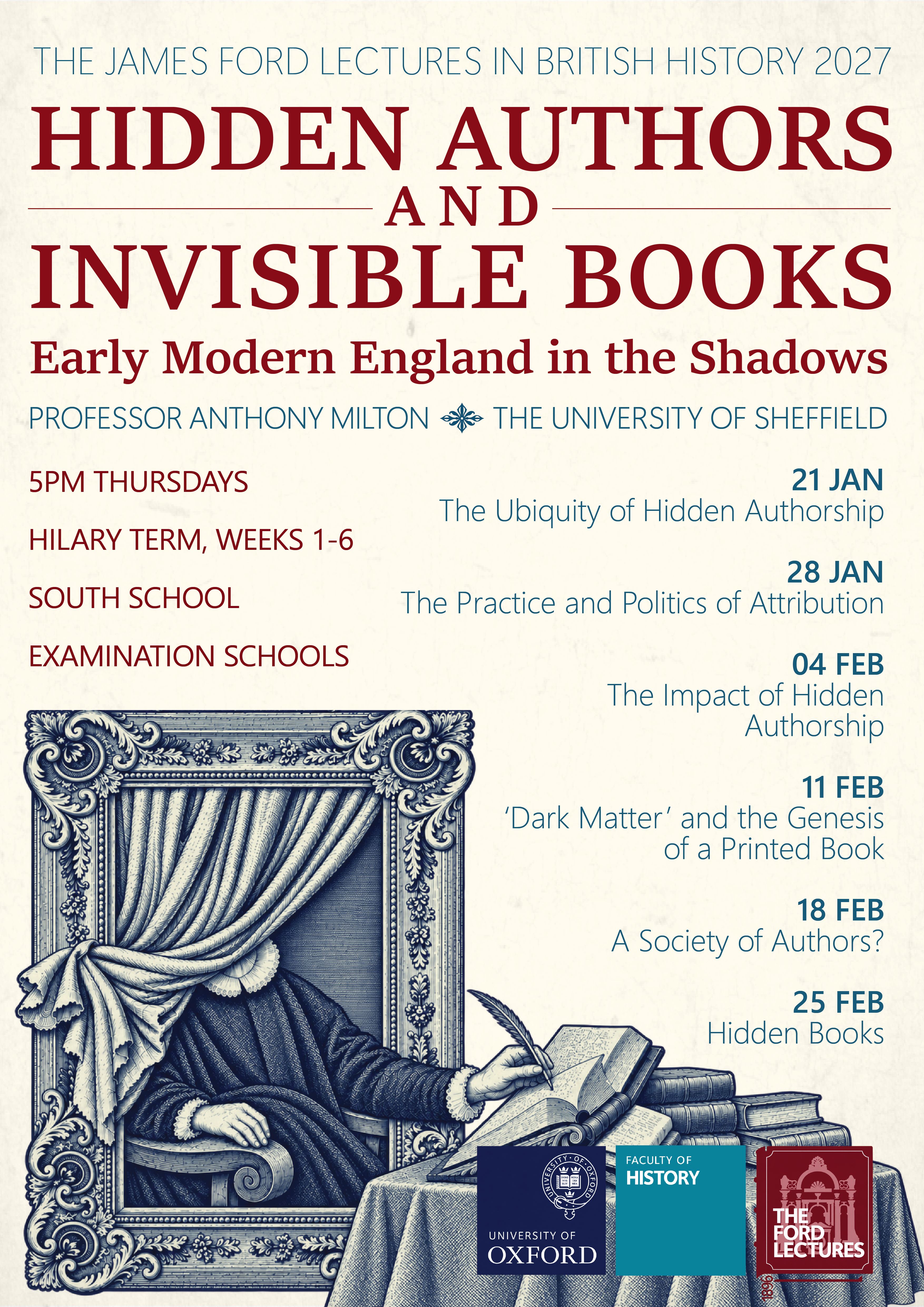

The James Ford Lectures in British History 2027
‘Dark matter’ and the Genesis of a Printed Book
11 February 17:00 | South School, Examination Schools
Professor Anthony Milton (University of Sheffield)
The printed books that we study as historians entice us with the notion of a totalizing embrace of past thought that can even yield to quantitative analysis. But the familiar narrative of how a manuscript text achieves printed form often passes over the multitude of other unprinted texts that might have shaped this process. The ‘dark matter’ of the Gutenberg Galaxy is not confined to missing incunabula. In tracing the genesis of a printed text this lecture seeks to highlight these many alternative texts and the arguably unrepresentative nature of the printed work that we now access.
About the series
Hidden Authors and Invisible Books: Early Modern England in the Shadows
The mindset of early modern England can seem literally an open book when we contemplate the more than 146,000 printed titles available on the Early English Books Online (EEBO) database for the period 1473-1700. Yet this was also an age of acute textual ambiguity, when a substantial proportion of printed texts appeared either without an author’s name, or with a false or misleading one. Moreover, this was a time when an avalanche of books and other composed texts were devised and/or composed which cannot be found on EEBO, but which nevertheless often crucially shaped the nature and meaning of the printed texts that we can access. These lectures will explore the myriad ways in which authorial identities were hidden, declared, misconstrued and forgotten during this period, and the implications of this for how contemporaries and later historians have read and understood texts. They will also consider the many forgotten writers and ‘invisible’ texts which can help challenge our assumptions of what it meant to be an ‘author’ and to compose a ‘book’ in this period.