Esther Hughes wins Women's History Network dissertation prize
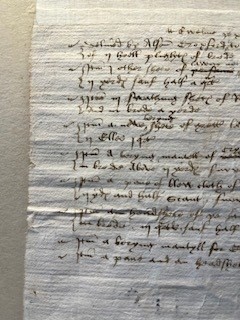
Exploring the materiality of the medieval noblewoman’s home: a comparison of the inventories of Alice Chaucer and Margery de la Beche
27 November 2026
My thesis uses a microhistorical analysis of the inventories of two noble medieval homes and the powerful women who lived in them to explore how gender, emotions, and material culture intersected in this period.
Rachel Delman’s exploration of Alice Chaucer’s tapestries and belongings in Gendered Viewing, Childbirth and Female Authority in the Home of Alice Chaucer provided particular inspiration for my thesis. The Chaucer inventory was written as Alice prepared for the birth of her grandchild at her ancestral home in Ewelme by importing goods from her other homes across the country. Although her substantial surviving records have made her the subject of historical investigation already, further exploration of her archives continues to provide valuable information about noblewomen’s lives in this period.
Margery de Poyning’s inventory was written by the royal court to protect her land and property when she was ‘bride-snatched’ by Sir John Dalton, who quickly became her third husband. Although the circumstances surrounding the inventory’s creation have been analysed by some historians, John Blair noted that its contents are considerably underresearched.
Alice and Margery lived strikingly similar lives. Both married three times, both were widowed by knightly husbands (allowing them to accumulate significant wealth), both produced one heir, and they lived only 15 miles apart in rural Thames Valley estates on either side of the Oxfordshire-Berkshire border. Despite these clear parallels, they lived approximately one hundred years apart. Margery’s inventory was created in 1347 and Alice’s was written in 1466.
Detailed recordings of noblewomen’s lives in this period are naturally rare as women were typically defined by their husband’s name and success. Therefore, although they should not be used to determine the norm for noblewomen in this period, my thesis concluded that a microhistorical study of material culture in these inventories can provide insight into nostalgia, family, and identity where personal written records do not exist. Analysing the similarities between these records and experiences concluded noblewomen’s possessions reflected their intentions to enhance wider family legacy while simultaneously retaining a sense of personal identity.
My analysis of the inventories was threefold, focussing on: imagery; heraldry; and old, damaged items. Both inventories contained significant animal and nature imagery. In public spaces within the home, this reveals women’s role in displaying family unity and nobility in securing wider family legacy and maintaining a positive perception. For example, in spaces such as the chamber, which would have been used much like a drawing room to receive visitors, the inventories list belongings with images of the forest, birds and ‘hawking’, and hunting. These items suggest connections to land were important symbols of prosperity and affluence, separating families from their urban identities by linking them to settings in which they participated in noble activities, such as hunting. Although these images suggest a reinforcement of a public family identity, they may also have acted as personal reminders to these women of their own growth in status and power through their multiple marriages. This demonstrates the intentional design of the medieval noble home, and a certain responsibility for these women to continue the legacies of the families they have married into.
Both inventories record significant quantities of old and broken items, a topic much overlooked not only in analysis of Alice and Margery’s inventories but in wider historiography. These items demonstrate nostalgia on a personal level, highlighting how an object’s function may have changed with age (or no longer serve a practical function at all) leading it to hold an emotional and inherently personal value. For example, Margery’s inventory records six cushions, eight rugs, and multiple coverlets all listed as ‘old’ and ‘green’. These items reflect Margery’s personal lineage as her father’s, Sir Michael de Poynings, heraldry was green and gold. They also appear to form a matching set, which implies that they were given as a gift, perhaps to mark a previous marriage and the merging of two lineages. This explains why they were not replaced despite their aging appearance, as they link closely to Margery’s personal identity and experiences. The damaged items in Alice and Margery’s inventories suggest a sense of permanence and stability through personal identity, acting as reminders of their roots through the changing identities they both held across their lives.
Heraldry in both inventories largely focused on matrilineal legacy in public and private spaces, opposing the historiographical view that the gentry thought in patrilineal terms. For example, Alice’s inventory lists cushions arriving with lions embroidered on them. Her mother’s Maud Burghersh’s heraldry contained lions and Alice clearly engaged with her maternal lineage frequently throughout her life as the Bhurghersh arms feature prominently and publicly on her tomb. Heraldry in the inventories depicts the rich, complex histories of widows in this period and highlights that preserving identities from across noblewomen's lives was of primary importance to them. This reinforces that noblewomen intended to represent both wider family heritage and personal importance in their homes.
The similarities between Alice’s and Margery’s inventories conclude that medieval noblewomen aimed for advancement at two levels: familial and personal. Although the inventories were written over a century apart, their similarities suggest that women’s concerns remained consistent in the late medieval period. Noblewomen ensured personal survival through multiple marriages (gaining them land and property), which in turn cemented the success and reputation of their descendents. Belongings in both medieval homes appear closely linked to the matriarch as a constant presence throughout the instability of medieval family life, simultaneously demonstrating personal reflection and wider family legacies. Material culture reflects these personal experiences through memory and nostalgia, particularly when used in private spaces such as the wardrobe. Conversely, possessions displayed in public spaces, such as the chamber, displayed lineage, wealth, and pride in family reputation.
Feedback from the Women’s History Network committee included: ‘This was a rich, compelling dissertation which undertakes a close and detailed analysis of two medieval noblewomen and inventories with strong supplemental primary material. It challenges historiography in an impressive way for an undergraduate dissertation and presents a compelling argument throughout the dissertation.’
I am thankful to my supervisor Dr Helen Lacey, who has nurtured my interest in medieval history throughout my degree and provided valuable support while writing my dissertation.